
Round table around judge Bill Warren
Author: Begoña Pascua Interviewee: Bill Warren Published in: 2000 English translation: artificial intelligence The article records a round table with judge Bill Warren about the Bullmastiff. Through questions and answers, it discusses key aspects of the breed such as bite, prognathism, mask, ears, bone, movement, dysplasia, temperament, family breeding versus large-kennel breeding, and the difference between English and American lines. The text stresses the importance of always judging the dog as a whole, preserving breed type and breeding with common sense.
By @a.myanimal
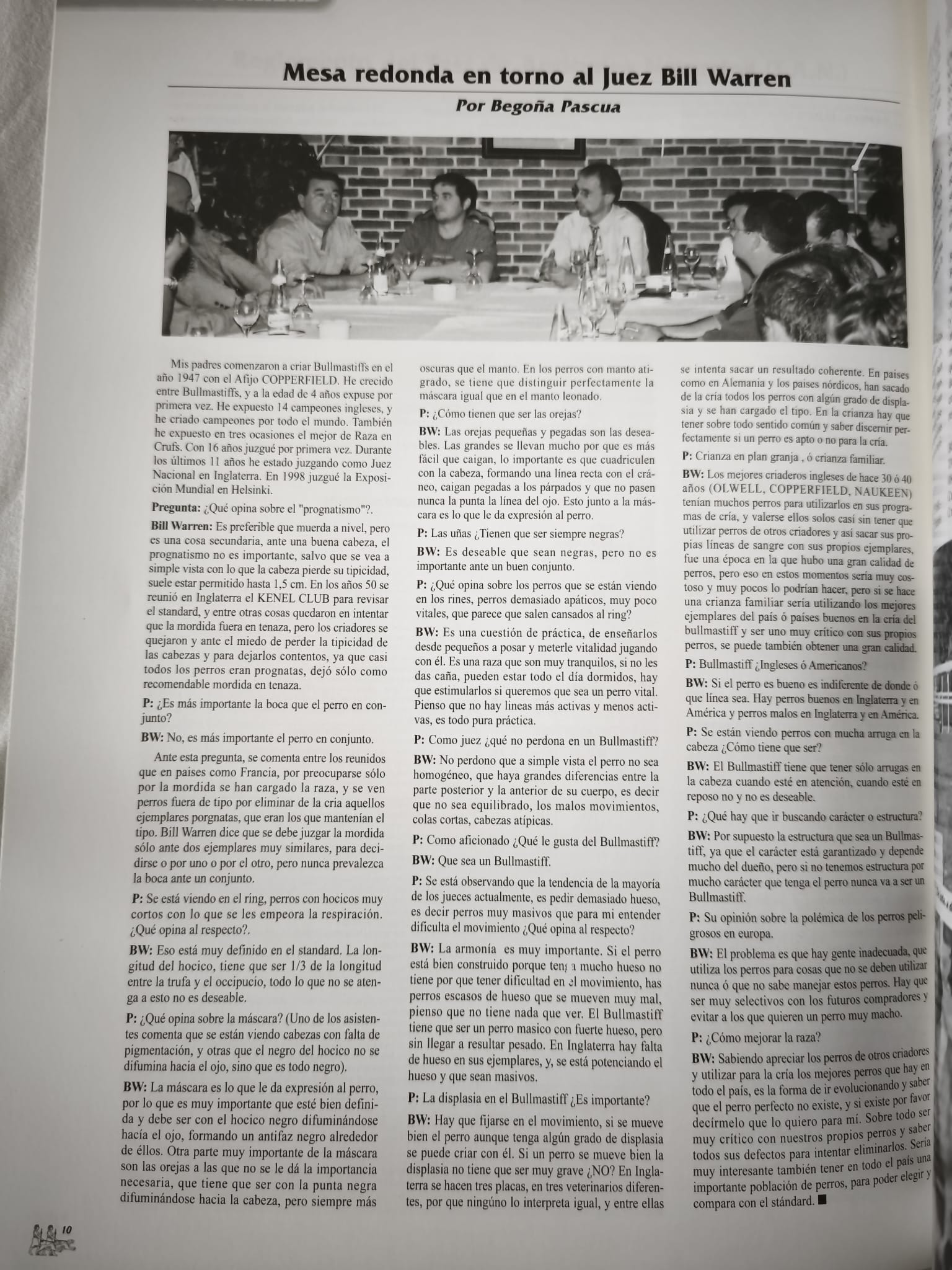
By Begoña Pascua
My parents began breeding Bullmastiffs in 1947 under the COPPERFIELD affix. I grew up among Bullmastiffs, and at the age of 4 I showed for the first time. I have shown 14 English champions and bred champions all over the world. I have also shown Best of Breed at Crufts on three occasions. At 16 I judged for the first time. For the last 11 years I have been judging as a National Judge in England. In 1998 I judged the World Dog Show in Helsinki.
Question: What is your opinion on “prognathism”?
Bill Warren: It is preferable for the bite to be level, but it is secondary. With a good head, prognathism is not important, unless it is visible at first sight, in which case the head loses its typicity. Up to 1.5 cm is usually permitted. In the 1950s, the KENNEL CLUB met in England to revise the standard and, among other things, they attempted to make a pincer bite the desired bite. Breeders complained because they feared losing the typicity of the heads, and to keep them satisfied, since almost all the dogs were prognathous, the pincer bite was left only as recommended.
Q: Is the mouth more important than the dog as a whole?
BW: No, the dog as a whole is more important.
Regarding this question, some of those present commented that in countries such as France, by worrying only about the bite, they have damaged the breed, and dogs outside type are seen because prognathous specimens, which were the ones maintaining type, were eliminated from breeding. Bill Warren says that the bite should only be judged between two very similar specimens, to decide on one or the other, but the mouth should never prevail over the whole.
Q: Dogs with very short muzzles are being seen in the ring, which worsens their breathing. What is your opinion on this?
BW: That is very clearly defined in the standard. The length of the muzzle must be one third of the length between the nose and the occiput; anything that does not conform to this is not desirable.
Q: What is your opinion on the mask? One of the attendees comments that heads are being seen with lack of pigmentation, and another says that the black of the muzzle does not fade toward the eye, but is entirely black.
BW: The mask is what gives expression to the dog, so it is very important that it be well defined, and it must consist of a black muzzle fading toward the eye, forming a black mask around them. Another very important part of the mask is the ears, which are not given the importance they deserve; they must have black tips fading toward the head, but always darker than the coat. In dogs with brindle coats, the mask must be perfectly distinguishable, just as in fawn coats.
Q: How should the ears be?
BW: Small and close-fitting ears are desired. Large ears are often seen because they fall more easily. The important thing is that they square with the head, forming a straight line with the skull, falling close to the eyelids and never going beyond the tip of the line of the eye. This, together with the mask, is what gives expression to the dog.
Q: Do the nails always have to be black?
BW: It is desirable that they be black, but it is not important when faced with a good overall dog.
Q: What is your opinion about the dogs being seen in the rings, dogs that are too apathetic, with very little vitality, which seem to enter the ring tired?
BW: It is a matter of practice, of teaching them from puppyhood to stand and to show vitality by playing with them. It is a very calm breed; if you do not stimulate them, they can spend the whole day asleep. They must be stimulated if we want them to be lively dogs. I do not think there are more active and less active lines; it is all purely practice.
Q: As a judge, what do you not forgive in a Bullmastiff?
BW: I do not forgive a dog that, at first sight, is not homogeneous, that has great differences between the rear and the front of its body, that is, that is not balanced; bad movement, short tails, atypical heads.
Q: As an enthusiast, what do you like about the Bullmastiff?
BW: That it is a Bullmastiff.
Q: It is being observed that the tendency of most judges today is to ask for too much bone, that is, very massive dogs which, in my opinion, make movement difficult. What is your opinion on this?
BW: Harmony is very important. If the dog is well built, having a lot of bone does not mean it must have difficulty moving. There are dogs lacking bone that move very badly; I think it has nothing to do with it. The Bullmastiff must be a massive dog with strong bone, but without becoming heavy. In England there is a lack of bone in the specimens, and bone and massiveness are being promoted.
Q: Is dysplasia important in the Bullmastiff?
BW: One must look at movement. If the dog moves well, even if it has some degree of dysplasia, it can be bred from. If a dog moves well, the dysplasia cannot be very serious, can it? In England, three plates are taken by three different veterinarians, because none interprets them in the same way, and between them an attempt is made to obtain a coherent result. In countries such as Germany or the Nordic countries, all dogs with any degree of dysplasia have been removed from breeding, and they have damaged the type. In breeding, above all, common sense is needed, and one must know how to discern perfectly whether a dog is fit for breeding or not.
Q: Farm-style breeding or family breeding?
BW: The best English breeders of 30 or 40 years ago, OLWELL, COPPERFIELD, NAUKEN, had many dogs to use in their breeding programs, and they managed by themselves without having to use dogs from other breeders, thus creating their own bloodlines with their own specimens. It was a time when there was great quality in dogs, but nowadays that would be very costly and very few could do it. However, if family breeding is carried out using the best specimens in the country, or in countries good at breeding Bullmastiffs, and being very critical of one’s own dogs, great quality can also be obtained.
Q: Bullmastiff, English or American?
BW: If the dog is good, it does not matter where it comes from or what line it is. There are good dogs in England and in America, and bad dogs in England and America.
Q: Dogs with a lot of wrinkle on the head are being seen. How should it be?
BW: The Bullmastiff should only have wrinkles on the head when it is alert; when at rest, it is not desirable.
Q: What should be sought, temperament or structure?
BW: Of course, the structure, that it be a Bullmastiff, since temperament is guaranteed and depends a lot on the owner. But if we do not have structure, no matter how much temperament the dog has, it will never be a Bullmastiff.
Q: Your opinion on the controversy over dangerous dogs in Europe.
BW: The problem is that there are unsuitable people who use dogs for things they should never be used for, or who do not know how to handle these dogs. One must be very selective with future buyers and avoid those who want a very macho dog.
Q: How can the breed be improved?
BW: By knowing how to appreciate the dogs of other breeders and using for breeding the best dogs in the whole country; that is the way to evolve, and to know that the perfect dog does not exist — and if it does, please tell me, because I want it for myself. Above all, one must be very critical of one’s own dogs and know all their faults in order to try to eliminate them. It would also be very interesting to have an important population of dogs throughout the country, in order to be able to choose and compare with the standard.
Frequently asked questions
What is the ideal bite for a Bullmastiff?
It is preferable for the bite to be level, but up to 1.5 cm of prognathism is usually permitted. The bite is secondary to a good head and should not prevail over the dog as a whole.
How important is the mask on a Bullmastiff?
The mask is very important as it gives expression to the dog. It must be well defined, black, and fade towards the eye. The ears also contribute to the mask and expression.
What is the judge's opinion on Bullmastiff movement and bone structure?
Harmony is crucial. A massive dog with strong bone should move well. Lacking bone does not guarantee good movement, and excessive bone should not impede movement. Common sense is needed in breeding.
Is dysplasia a major concern for Bullmastiff breeding?
If a dog moves well, even with some dysplasia, it can be bred from. Common sense is needed to discern if a dog is fit for breeding, rather than strictly eliminating all dogs with any degree of dysplasia.
What is more important: Bullmastiff temperament or structure?
Structure is paramount because temperament is guaranteed and depends on the owner. Without the correct structure, the dog will never be a true Bullmastiff, regardless of its temperament.
Related articles
Colors in the Molosos de Arena, September 1994
Author: Gilbert de Mulder Published in: “Club Español de los Molosos de Arena” Date: September 1994 English translation: artificial intelligence The article introduces a series dedicated to the genetics of coat color in the breeds grouped as Molosos de Arena. Gilbert de Mulder explains the basic functioning of genes and alleles related to coat color, focusing especially on the “S” locus and its influence on the appearance of white markings. The text analyzes specific cases in the Mastiff, Bullmastiff, Neapolitan Mastiff, Dogue de Bordeaux and Fila Brasileiro, defending the importance of studying pedigrees and breeding lines in order to avoid undesirable genetic combinations.
Mastiff, Bullmastiff, Fila Brasileiro, Dogue de Bordeaux and Neapolitan Mastiff: together, but not mixed, February 1997
Author: J. M. Castillo Published in: “Club Español de los Molosos de Arena” Date: February 1997 Original translation: not indicated in the article English translation: artificial intelligence The article analyzes the morphological, historical and functional differences between several molossoid breeds included within the group known as “Molosos de Arena”. J. M. Castillo focuses especially on the Mastiff and compares it with the Bullmastiff, the Fila Brasileiro, the Neapolitan Mastiff and the Dogue de Bordeaux. The author warns against confusion between breeds, the indiscriminate use of crosses, the exaggerated search for size and the tendency to justify modern breeds through imprecise historical references. His main thesis is that these breeds may be related, but they must preserve their identity, type and specific characteristics.
Colors in the Fila Brasileiro, July 1993
Published in: “Club Español de los Molosos de Arena” Date: July 1993 English translation: artificial intelligence The article addresses the controversy surrounding accepted colors in the Fila Brasileiro and defends the CAFIB position regarding the rejection of black as a correct color in the breed. Mar Olivas Tur argues that other colors and combinations, such as white, brindle, sand and cinza champagne, are part of the history and authenticity of the Fila. The text insists that the quality of a specimen should not be judged exclusively by the color of its coat, but by its correctness, typicity and racial value.
Tosa-Inu: the noble samurai
Author/commentary: D. Javier Sánchez Fernández, international judge Published in: “CLUB ESPAÑOL DE LOS MOLOSOS DE ARENA” magazine Date: 2000 English translation: artificial intelligence D. Javier Sánchez Fernández analyzes the Tosa-Inu from his experience as an international judge and expert on Japanese breeds. The article addresses the cultural value of the Tosa in Japan, its relationship with samurai tradition, its character as a ceremonial fighting dog, the difficulty of accessing authentic specimens outside Japan, and the risks of losing typicity when the breed is interpreted through Western show criteria. The importance of head, expression, mobility, temperament and preservation of racial identity is also emphasized.
The ideal age to breed the male and female Fila Brasileiro, April 1994
Author: Paulo Santos Cruz The article analyzes the reasons why CAFIB established restrictive rules regarding the minimum breeding age and the rest periods between litters in the Fila Brasileiro. Paulo Santos Cruz argues that sexual maturity is not the same as full physical maturity, especially in large and molossoid breeds. The author explains that breeding males and females too early can harm the health of the dogs, weaken selection, and compromise the quality of the breed. The article was published by Paulo Santos Cruz in the magazine “CLUB ESPAÑOL DE LOS MOLOSOS DE ARENA” in April 1994 and translated by artificial intelligence.
Dysplasia in the Dogue de Bordeaux, September 1994
Author: Dr. Fontaine Published in: “Club Español de los Molosos de Arena” Date: September 1994 Lecture: Saturday, 6/11/93 Spanish translation: P. Llorca English translation: artificial intelligence The article records a lecture by Dr. Fontaine on dysplasia in the Dogue de Bordeaux. The text addresses hereditary, environmental, nutritional and exercise-related factors that may influence the appearance or worsening of dysplasia. It also explains the importance of radiography, correct positioning of the dog, the first hip-reading statistics in the breed and the need to carry out controls before using dogs for breeding.