
Tosa-Inu: the noble samurai
Author/commentary: D. Javier Sánchez Fernández, international judge Published in: “CLUB ESPAÑOL DE LOS MOLOSOS DE ARENA” magazine Date: 2000 English translation: artificial intelligence D. Javier Sánchez Fernández analyzes the Tosa-Inu from his experience as an international judge and expert on Japanese breeds. The article addresses the cultural value of the Tosa in Japan, its relationship with samurai tradition, its character as a ceremonial fighting dog, the difficulty of accessing authentic specimens outside Japan, and the risks of losing typicity when the breed is interpreted through Western show criteria. The importance of head, expression, mobility, temperament and preservation of racial identity is also emphasized.
By @a.myanimal
Comments by D. Javier Sánchez Fernández, International Judge
On this occasion we have the pleasure of interviewing, without doubt, the most international of our judges, with recognized prestige inside and outside Spain, a great lover of molossers and especially of all Japanese breeds. Specifically, he will provide us with valuable knowledge and experiences from his trips to Japan, which are not to be missed, where he has known the TOSA in its own environment, where it is appreciated and almost idolized. In our country, it is surely one of the least known breeds, but it is not inferior in any respect to the others, which have more admirers; on the contrary, this breed possesses characteristics and qualities that, in the words of one of its greatest supporters, make it “the most spectacular breed in the world”.
How many trips have you made to Japan to see dogs or judge them? Which Japanese breeds have you studied?
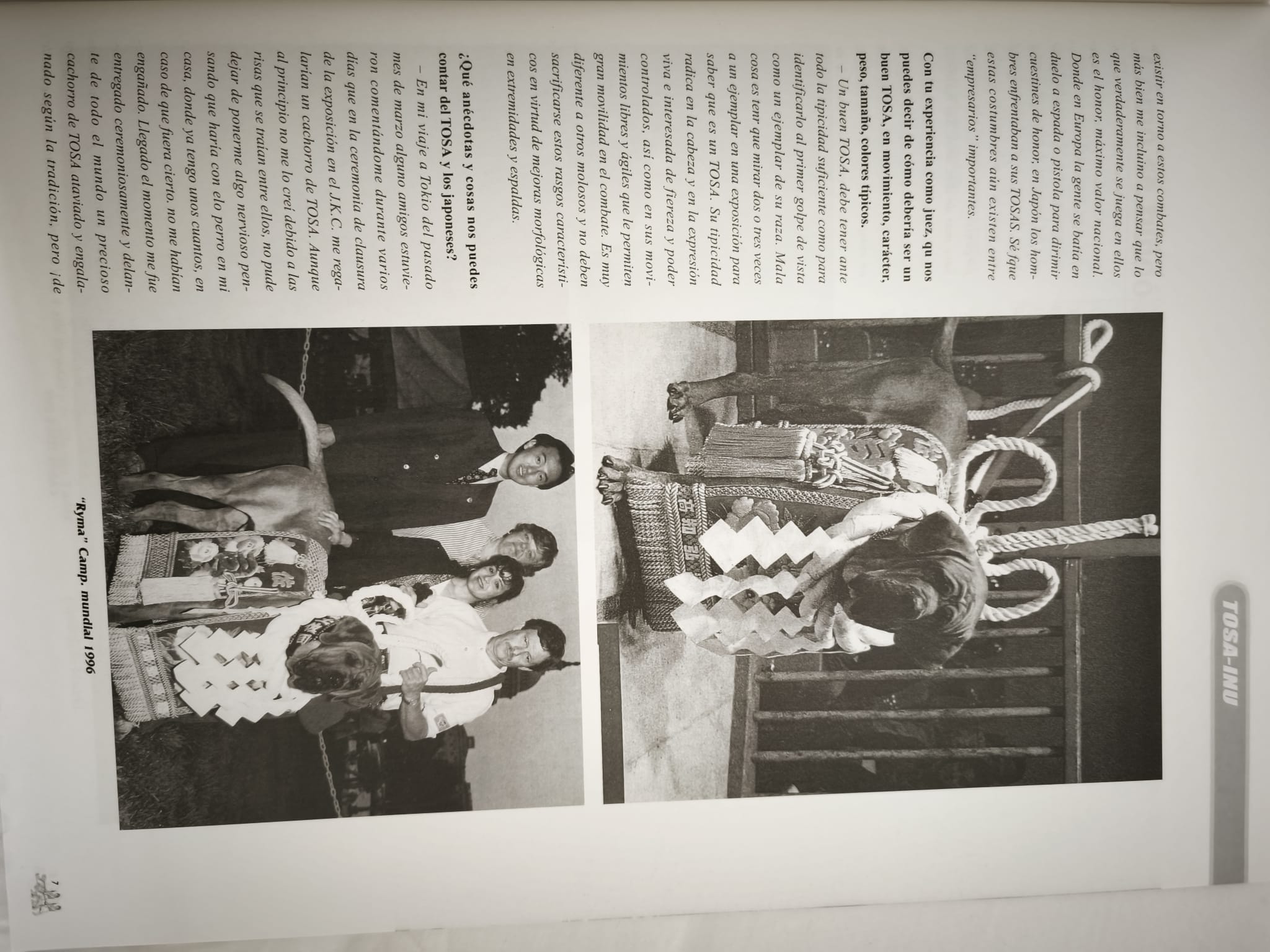
— I have visited Japan on twelve occasions, eight of them to judge, if I remember correctly. The first was in 1982 on the occasion of the F.C.I. World Dog Show held in Tokyo. There, a TOSA specimen was presented with exactly the same ceremony that was used on my most recent visit this year: kimonos, flags, drums, etc.
I have studied all Japanese breeds with great interest, but especially those belonging to the Groups I am qualified to judge.
What did you think the first time you saw a TOSA?
— That TOSA in Tokyo in 1982 was the first one I had ever seen. Although, as a cynologist, I must prevent certain things from impressing me so that they do not limit my capacity for objective analysis, that dog managed to do so, and I remember that I could not take my eyes off him. He had great typicity, although also certain structural or breeding defects. His photographs were published in DOGY PEOPLE, the magazine I edited in those years.
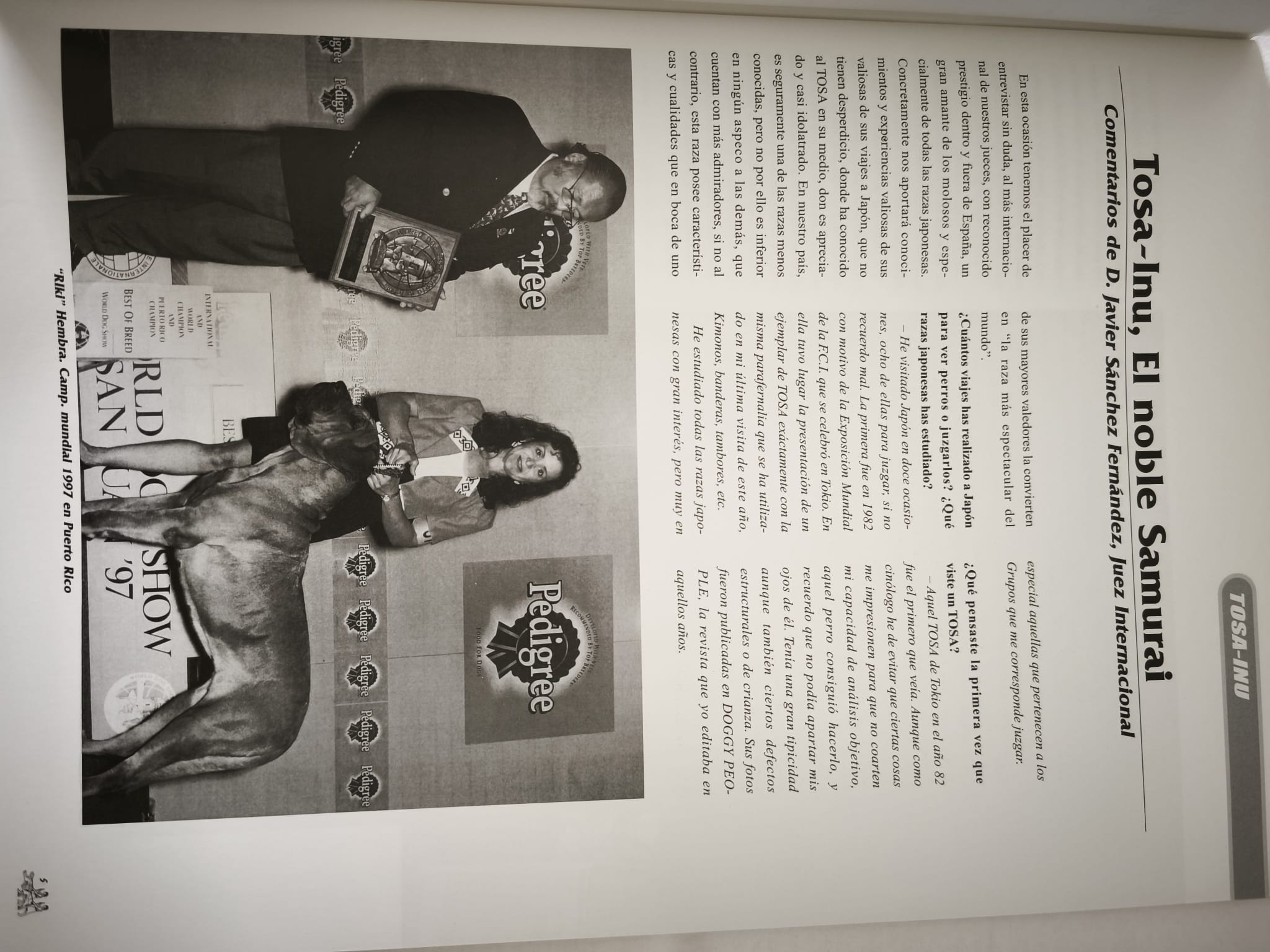
“Riki”, female. World Champion 1997 in Puerto Rico.
Contemplating a good TOSA is always an unforgettable experience, although this happens very rarely. The Japanese only show the large adult males, which possess the zootechnical characteristics accentuated to the maximum, and never the females. Perhaps herein lies the mystery of the scarce reality of the TOSA. Who are the TOSA females and what are they like?
The Japanese use the Tosa for combat and ceremonies. What do Tosas mean in Japanese culture?
— The TOSA is surrounded by much mystery. In matters of dogs and, in general, in everything related to Japanese culture and society, things can be known and discovered up to a certain level, but beyond that, it is impossible to go deeper and reach truth and reality. Japan’s relations with the West are governed by propagandistic tactics. What is known about Japan is what they want to be known, and what is not known is what they do not want to tell, whatever the reasons may be, often because of a high sense of dignity and privacy in order to preserve their authentic signs of identity, which would be prostituted by excessive disclosure and would not be easily understood by other cultures.
Today, a good TOSA is a sign of power, like a racehorse or a good painting by a famous artist, and normally the person who owns one has not chosen it at random among other breeds, but has bred it following a family tradition and possesses considerable financial means. The TOSA also creates several jobs around it, since each dog has several personal caretakers, such as physical trainers, feeding managers, veterinarians, etc.
The TOSA is a fighting dog, but we understand that these combats have nothing to do with the cruel and bloody “pit” fights carried out illegally in our country. What can you tell us about this? Have you seen any combat?
— Indeed, they have nothing to do with each other. One belongs to an ancient tradition of noble samurai based on honor and respect for the dogs themselves, and the other is the pastime of a marginal, uncultured and pathetic social class that I consider the toxic-human waste of large cities and their outskirts.
I have never seen any combat, nor have I ever been invited to do so, but I have met people connected with it, in Tokyo and Tokaimura. It is something very private among Japanese people and difficult for foreigners to access, but I personally have no interest in it. I do not know what financial circulation may exist around these combats, but I am more inclined to think that what is truly at stake in them is honor, the highest national value. Where in Europe people dueled with sword or pistol to settle matters of honor, in Japan men faced each other through their TOSAS. I know that these customs still exist among important “businessmen”.
With your experience as a judge, what can you tell us about how a good TOSA should be, in movement, temperament, weight, size and typical colors?
— A good TOSA must, above all, have sufficient typicity to be identified at first glance as a specimen of its breed. It is a bad sign if one has to look two or three times at a specimen in a show to know that it is a TOSA. Its typicity lies in the head and in the lively and interested expression of controlled fierceness and power, as well as in its free and agile movements, which allow it great mobility in combat. It is very different from other molossers, and these characteristic traits must not be sacrificed in favor of morphological improvements in limbs and backs.
What anecdotes and things can you tell us about the TOSA and the Japanese?
— During my trip to Tokyo last March, some friends spent several days telling me that at the closing ceremony of the J.K.C. show I would be given a TOSA puppy. Although at first I did not believe it because of the laughter among them, I could not help becoming somewhat nervous thinking about what I would do with the dog at home, where I already have many dogs, in case it was true. They had not deceived me. When the time came, I was ceremoniously presented, in front of everyone, with a beautiful TOSA puppy dressed and adorned according to tradition, but it was a plush toy! I am delighted because it gives me no problems with my other dogs. I do regret, however, that it is not available for breeding!
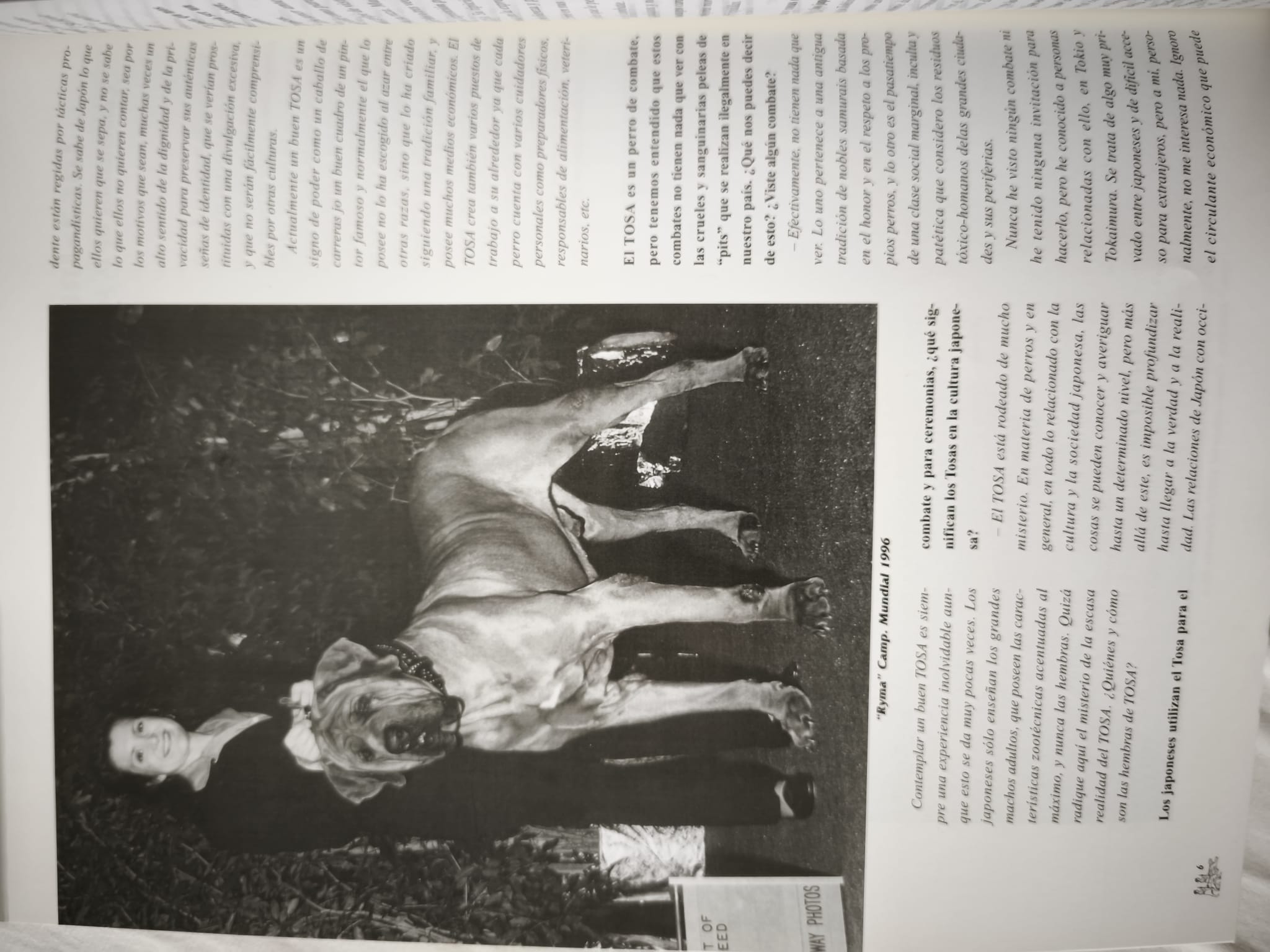
“Ryma”, World Champion 1996.
How do you see the level of TOSAS outside Japan, specifically in Europe and Spain?
— Quite simply, I do not see it. Authentic TOSAS are far too scarce and, today, the Japanese are not interested in spreading them as they have done with the Akita or the Shiba, because this is a breed that belongs to a different “status”, far removed from the official cynophilia of dog shows.
Recently I saw some TOSAS in Budapest that were laughable. Without doubt, in certain Eastern European countries a completely false TOSA is being “manufactured” from some of the breeds that once took part in its creation, and also from the FILA. The result will never be the same, because those breeds today are very different from how they were then, and furthermore, it is unknown in what proportion and dosage they were used, to what extent and with what cadence over time.
It is very probable that the TOSA of the future will end up being produced in the U.S.A., where there are already quite a few. It will be a dog of impeccable structure and conformation which, judged by American “all-rounders” according to general concepts, will have lost much of its typicity.
Recently you judged at the Asian Championship, which for us would be like the European Championship. What kind of TOSAS did you see? What conclusion did you draw from the TOSAS exhibited?
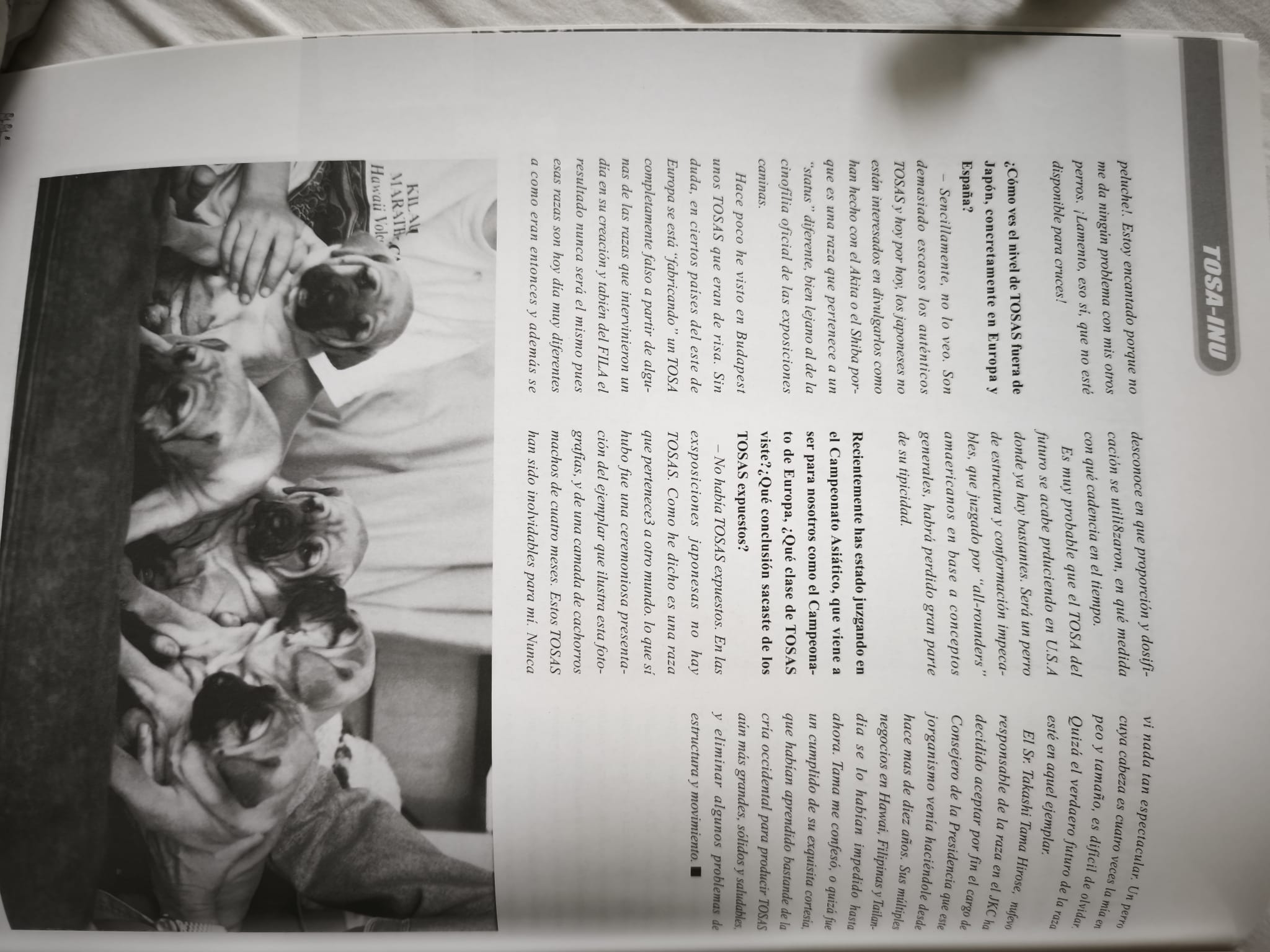
— There were no TOSAS exhibited. In Japanese shows there are no TOSAS. As I have said, it is a breed that belongs to another world. What there was, however, was a ceremonial presentation of the specimen that illustrates these photographs, and of a litter of four-month-old male puppies. These TOSAS have been unforgettable for me. I have never seen anything so spectacular. A dog whose head is four times mine in weight and size is difficult to forget. Perhaps the true future of the breed lies in that specimen.
Mr. Takashi Tama Hirose, the new person responsible for the breed at the JKC, has finally decided to accept the position of Presidential Adviser that this organization had been offering him for more than ten years. His multiple businesses in Hawaii, the Philippines and Thailand had prevented him from doing so until now. Tama confessed to me, or perhaps it was a compliment born of his exquisite courtesy, that they had learned quite a lot from Western breeding in order to produce even larger, more solid and healthier TOSAS, and to eliminate some problems of structure and movement.
Frequently asked questions
What is the cultural significance of the Tosa-Inu in Japan?
In Japan, the Tosa-Inu is a sign of power, associated with family tradition and considerable financial means. It is also linked to an ancient tradition of honor and respect, historically used in ceremonial combats as a way for men to settle matters of honor.
How does the Tosa-Inu differ from Western show criteria?
The article highlights the risk of losing the Tosa-Inu's typicity when interpreted through Western show criteria. Emphasis is placed on preserving its unique head, expression, mobility, and temperament, which are distinct from other molossers and crucial for its breed identity.
Are authentic Tosa-Inu specimens easily found outside Japan?
No, authentic Tosa-Inu specimens are very scarce outside Japan. The Japanese are not actively spreading the breed internationally as they have with other Japanese breeds like the Akita or Shiba, as it belongs to a different status far removed from official dog shows.
What are the characteristics of a good Tosa-Inu according to D. Javier Sánchez Fernández?
A good Tosa-Inu must have sufficient typicity to be identified at first glance. This includes a distinctive head, a lively and interested expression of controlled fierceness and power, and free, agile movements that allow great mobility. These traits should not be sacrificed for morphological improvements.
What is the difference between Japanese Tosa combats and Western dog fights?
Japanese Tosa combats are described as part of an ancient tradition of honor and respect for the dogs, akin to samurai duels. This is contrasted with cruel and bloody 'pit' fights, considered the pastime of a marginal and uncultured social class.
Related articles
Colors in the Fila Brasileiro, July 1993
Published in: “Club Español de los Molosos de Arena” Date: July 1993 English translation: artificial intelligence The article addresses the controversy surrounding accepted colors in the Fila Brasileiro and defends the CAFIB position regarding the rejection of black as a correct color in the breed. Mar Olivas Tur argues that other colors and combinations, such as white, brindle, sand and cinza champagne, are part of the history and authenticity of the Fila. The text insists that the quality of a specimen should not be judged exclusively by the color of its coat, but by its correctness, typicity and racial value.
The ideal age to breed the male and female Fila Brasileiro, April 1994
Author: Paulo Santos Cruz The article analyzes the reasons why CAFIB established restrictive rules regarding the minimum breeding age and the rest periods between litters in the Fila Brasileiro. Paulo Santos Cruz argues that sexual maturity is not the same as full physical maturity, especially in large and molossoid breeds. The author explains that breeding males and females too early can harm the health of the dogs, weaken selection, and compromise the quality of the breed. The article was published by Paulo Santos Cruz in the magazine “CLUB ESPAÑOL DE LOS MOLOSOS DE ARENA” in April 1994 and translated by artificial intelligence.
Colors in the Molosos de Arena, September 1994
Author: Gilbert de Mulder Published in: “Club Español de los Molosos de Arena” Date: September 1994 English translation: artificial intelligence The article introduces a series dedicated to the genetics of coat color in the breeds grouped as Molosos de Arena. Gilbert de Mulder explains the basic functioning of genes and alleles related to coat color, focusing especially on the “S” locus and its influence on the appearance of white markings. The text analyzes specific cases in the Mastiff, Bullmastiff, Neapolitan Mastiff, Dogue de Bordeaux and Fila Brasileiro, defending the importance of studying pedigrees and breeding lines in order to avoid undesirable genetic combinations.
Dysplasia in the Dogue de Bordeaux, September 1994
Author: Dr. Fontaine Published in: “Club Español de los Molosos de Arena” Date: September 1994 Lecture: Saturday, 6/11/93 Spanish translation: P. Llorca English translation: artificial intelligence The article records a lecture by Dr. Fontaine on dysplasia in the Dogue de Bordeaux. The text addresses hereditary, environmental, nutritional and exercise-related factors that may influence the appearance or worsening of dysplasia. It also explains the importance of radiography, correct positioning of the dog, the first hip-reading statistics in the breed and the need to carry out controls before using dogs for breeding.
Dilated cardiomyopathy in molossers: symptoms, diagnosis and treatment
Author: Dr. Rosario Bergamín Published in: “CLUB ESPAÑOL DE LOS MOLOSOS DE ARENA” magazine Date: 2001 English translation: artificial intelligence Dr. Rosario Bergamín explains dilated cardiomyopathy in large dogs, especially molossers. The article describes its progressive nature, its possible genetic basis, the factors that may contribute to its development, its symptoms, diagnostic methods and treatment options. It also highlights the importance of periodic cardiac check-ups, especially before anesthesia or surgery, in order to detect the disease in early stages and improve survival.
Round table around judge Bill Warren
Author: Begoña Pascua Interviewee: Bill Warren Published in: 2000 English translation: artificial intelligence The article records a round table with judge Bill Warren about the Bullmastiff. Through questions and answers, it discusses key aspects of the breed such as bite, prognathism, mask, ears, bone, movement, dysplasia, temperament, family breeding versus large-kennel breeding, and the difference between English and American lines. The text stresses the importance of always judging the dog as a whole, preserving breed type and breeding with common sense.