
Colors in the Fila Brasileiro, July 1993
Published in: “Club Español de los Molosos de Arena” Date: July 1993 English translation: artificial intelligence The article addresses the controversy surrounding accepted colors in the Fila Brasileiro and defends the CAFIB position regarding the rejection of black as a correct color in the breed. Mar Olivas Tur argues that other colors and combinations, such as white, brindle, sand and cinza champagne, are part of the history and authenticity of the Fila. The text insists that the quality of a specimen should not be judged exclusively by the color of its coat, but by its correctness, typicity and racial value.
By @a.myanimal
Talking about the colors of the Fila always means entering into controversy. But it should not be that way. Regarding colors, my personal opinion is one of unconditional support for C.A.F.I.B. I support and understand the refusal to accept black; I have never seen a good and correct black Fila, and people with authority and knowledge of the Fila have confirmed the total absence of correct black Filas.
The same cannot be said of other color combinations. Brindle Filas with white markings, sand-colored Filas with white brushstrokes, white Filas with large brindle patches, cinza champagne... A beautiful cinza champagne female was SAVANNA DA CAROLINA, absolutely correct and wonderful; another of the great ones was BUGRE DO AQUENTA SOL. In cinza champagne, a mixture of ash and bluish cream color, there have been great Fila Brasileiros, because it is a color that, although difficult to obtain, is authentic.
It may also seem curious to see white Filas with only the head brindle, or the head and a very slight part of the body, but they have existed, they exist and they will exist.
I would like to look back and remember, in Germany, GOZADO DO MATO GROSSO, a worthy specimen of his breed, brindle with white socks, winner at German specialty shows and international exhibitions.
FACENDA CAROLINA, a very famous kennel name, with some very good Filas, most of them both brindle and cream, have large white markings on the body; thus we remember QUEIMADA DA FACENDA CAROLINA, BAGUA DA FACENDA CAROLINA... why not? White in the Fila is a basic color, since it appears, to a greater or lesser extent, accompanying the other colors: golden, brindle and sand.
But in all this mixture of colors we will never see a red Fila with brindle patches, or a brindle one with sand patches; or a cinza champagne with golden or brindle patches. The colors, although with a great variety of shades, from strong red, cream, sand; dark brindle, reddish, gray, etc., with their variants of white markings, are already determined when the Fila is pure.
Perhaps for people outside the Fila world a dog of uniform color may be more beautiful, all golden, all brindle. But we should not forget that white has always been present in the Fila; it is a color that belongs to the breed, let us not take it away. Cinza champagne is a surprising color in any of its shades, darker or lighter. Why deprive ourselves of it?
There are those who, unfortunately, prejudge by colors; that is, they like, for example, brindle Filas and will always try to make a brindle dog the winner, practically without seeing beyond the coat. It is true that colors can confuse the human eye: brindle colors, with their stripes or lines, can give the optical sensation of more bone or more power, while golden tones will give a greater sensation of lightness. Although, as in everything else, it is simply a matter of knowing how to see.
Whether a Fila is good or bad, correct or incorrect, typical or atypical, can never be based exclusively on the color of its coat. A Fila is not better or worse because we like or dislike its color. What is certain is that, from my smallness, I will always admire, and have always admired, the greatness of color that the Fila Brasileiro has, just like its country.
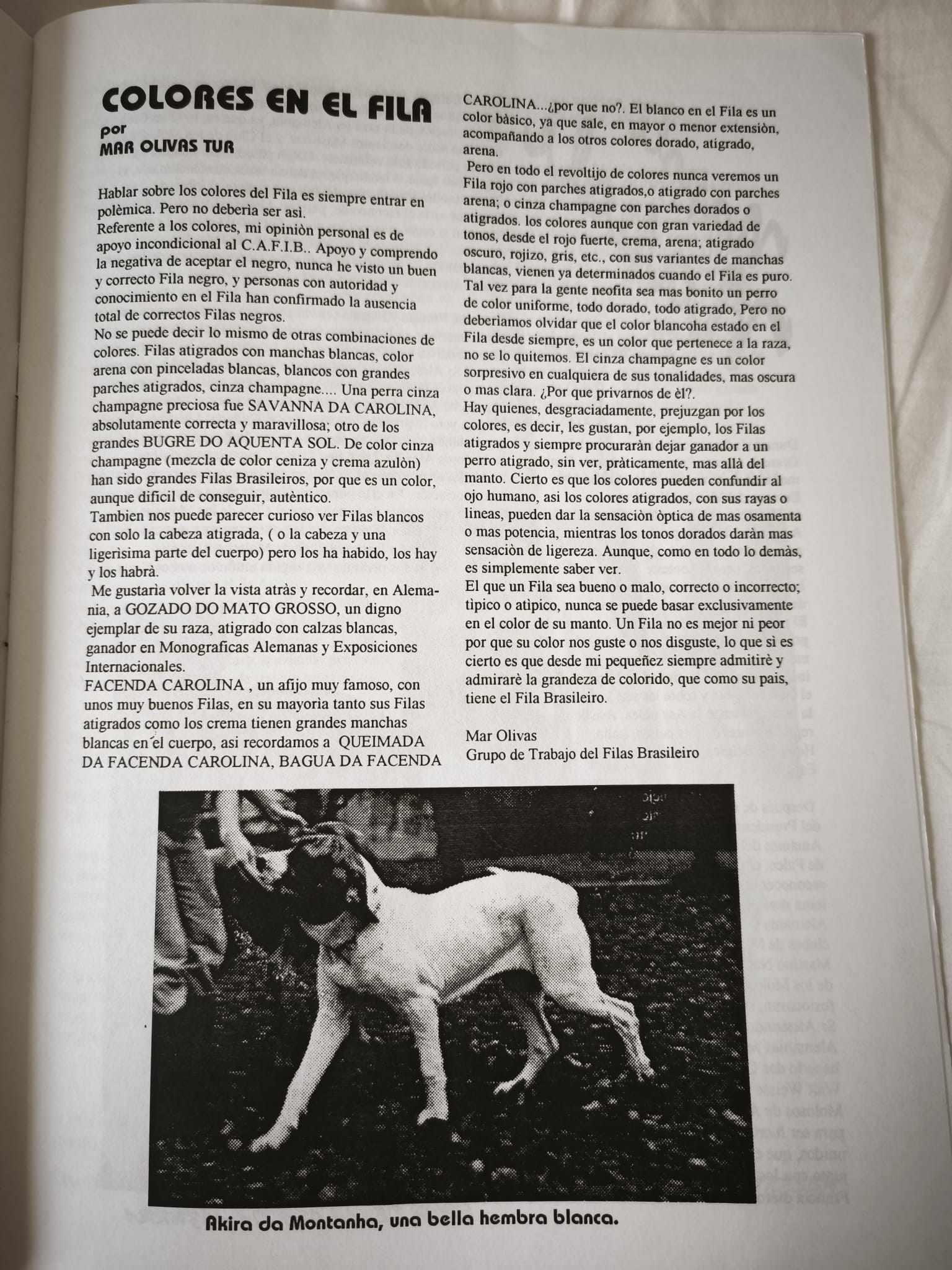
Akira da Montanha, a beautiful white female.
Frequently asked questions
What is the CAFIB position on black Fila Brasileiros?
The CAFIB position, as argued in the article, is the refusal to accept black as a correct color in the Fila Brasileiro breed, citing the absence of correct black specimens.
What are the accepted colors in the Fila Brasileiro according to the article?
The article mentions brindle with white markings, sand with white brushstrokes, white with large brindle patches, and cinza champagne as authentic and accepted colors.
Should a Fila Brasileiro's quality be judged solely by its color?
No, the article strongly argues that the quality of a Fila Brasileiro specimen should not be judged exclusively by its coat color, but by its correctness, typicity, and racial value.
Is white a common color in Fila Brasileiros?
Yes, white is considered a basic color that appears to a greater or lesser extent accompanying other colors like golden, brindle, and sand in the Fila Brasileiro.
Related articles
Versatility in the Fila Brasileiro, July 1993
Author: Clelia Kruel Drawing: Camburi do Embrema Published in: “Club Español de los Molosos de Arena” Date: July 1993 English translation: artificial intelligence The article presents the Fila Brasileiro as a breed deeply linked to Brazil’s rural history and highlights its versatility as a guard dog, hunting dog, companion and working dog. Clelia Kruel reviews its evolution from the Brazilian countryside to the cities, its international recognition and its role as a utility dog under extreme conditions, especially in tests carried out in the Amazon jungle. The text emphasizes its rusticity, endurance, sense of smell, strength, temperament and silent guarding ability.
Mastiff, Bullmastiff, Fila Brasileiro, Dogue de Bordeaux and Neapolitan Mastiff: together, but not mixed, February 1997
Author: J. M. Castillo Published in: “Club Español de los Molosos de Arena” Date: February 1997 Original translation: not indicated in the article English translation: artificial intelligence The article analyzes the morphological, historical and functional differences between several molossoid breeds included within the group known as “Molosos de Arena”. J. M. Castillo focuses especially on the Mastiff and compares it with the Bullmastiff, the Fila Brasileiro, the Neapolitan Mastiff and the Dogue de Bordeaux. The author warns against confusion between breeds, the indiscriminate use of crosses, the exaggerated search for size and the tendency to justify modern breeds through imprecise historical references. His main thesis is that these breeds may be related, but they must preserve their identity, type and specific characteristics.
Tosa-Inu: the noble samurai
Author/commentary: D. Javier Sánchez Fernández, international judge Published in: “CLUB ESPAÑOL DE LOS MOLOSOS DE ARENA” magazine Date: 2000 English translation: artificial intelligence D. Javier Sánchez Fernández analyzes the Tosa-Inu from his experience as an international judge and expert on Japanese breeds. The article addresses the cultural value of the Tosa in Japan, its relationship with samurai tradition, its character as a ceremonial fighting dog, the difficulty of accessing authentic specimens outside Japan, and the risks of losing typicity when the breed is interpreted through Western show criteria. The importance of head, expression, mobility, temperament and preservation of racial identity is also emphasized.
Round table around judge Bill Warren
Author: Begoña Pascua Interviewee: Bill Warren Published in: 2000 English translation: artificial intelligence The article records a round table with judge Bill Warren about the Bullmastiff. Through questions and answers, it discusses key aspects of the breed such as bite, prognathism, mask, ears, bone, movement, dysplasia, temperament, family breeding versus large-kennel breeding, and the difference between English and American lines. The text stresses the importance of always judging the dog as a whole, preserving breed type and breeding with common sense.
Talking About Dogs: The Old English Mastiff, September 1994
Author: Jesús Cano Published in: “Club Español de los Molosos de Arena” Date: September 1994 English translation: artificial intelligence The article continues a series dedicated to the Old English Mastiff, reviewing historical aspects related to its origin, evolution and functional use in Great Britain. Jesús Cano discusses the possible formation of the breed from native British dogs and Asian molossers, the Norman influence, the old Ban-Dog, the Lyme Hall bloodline, and the use of mastiff-type dogs in hunting, defense, bull-running, bull-baiting, bear-baiting and dog fighting. The text also reflects on how these practices contributed to the development of other canine types, especially the Bulldog and the Staffordshire Bull Terrier.
The ideal age to breed the male and female Fila Brasileiro, April 1994
Author: Paulo Santos Cruz The article analyzes the reasons why CAFIB established restrictive rules regarding the minimum breeding age and the rest periods between litters in the Fila Brasileiro. Paulo Santos Cruz argues that sexual maturity is not the same as full physical maturity, especially in large and molossoid breeds. The author explains that breeding males and females too early can harm the health of the dogs, weaken selection, and compromise the quality of the breed. The article was published by Paulo Santos Cruz in the magazine “CLUB ESPAÑOL DE LOS MOLOSOS DE ARENA” in April 1994 and translated by artificial intelligence.