
Talking About Dogs: The Old English Mastiff, September 1994
Author: Jesús Cano Published in: “Club Español de los Molosos de Arena” Date: September 1994 English translation: artificial intelligence The article continues a series dedicated to the Old English Mastiff, reviewing historical aspects related to its origin, evolution and functional use in Great Britain. Jesús Cano discusses the possible formation of the breed from native British dogs and Asian molossers, the Norman influence, the old Ban-Dog, the Lyme Hall bloodline, and the use of mastiff-type dogs in hunting, defense, bull-running, bull-baiting, bear-baiting and dog fighting. The text also reflects on how these practices contributed to the development of other canine types, especially the Bulldog and the Staffordshire Bull Terrier.
By @a.myanimal
By Jesús Cano.
Not long ago I spoke with Jaime Pérez Marhuenda — among other things, he is in charge of editing our Bulletin — and he told me that the Bulletin would still take some time to come out due to the shortage of articles he had received.
Therefore, it is clear that our Club still needs help from all of us to produce the Bulletin, and you will not deny that almost all of us are impatient to receive it. We must therefore think that, apart from personal contacts, telephone calls and shows, the Bulletin is the only means we have to stay in contact with one another. So, come on! Jaime is waiting for our collaboration.
In the previous Bulletin we began to speak about the Mastiff, perhaps the least known breed in our Club, apart from the Tosa, of course. We saw how it supposedly formed from a native breed of dog from Great Britain, to which blood from Asian Molossers had been added. Its physical appearance is difficult for us to imagine, since it may have resembled an enormous bulldog or, on the contrary, an Irish wolfhound; each person can use their imagination on this point. Although it must have been a medium-sized dog, broad-chested, strong-boned, with a short and strong muzzle, short and strong enough to hold prey, but not so excessively short that it would prevent it from breathing during the bite. It must not have been very fast at that time, but rather heavy and massive, capable by its mere force of knocking its opponents to the ground, whether men or animals.
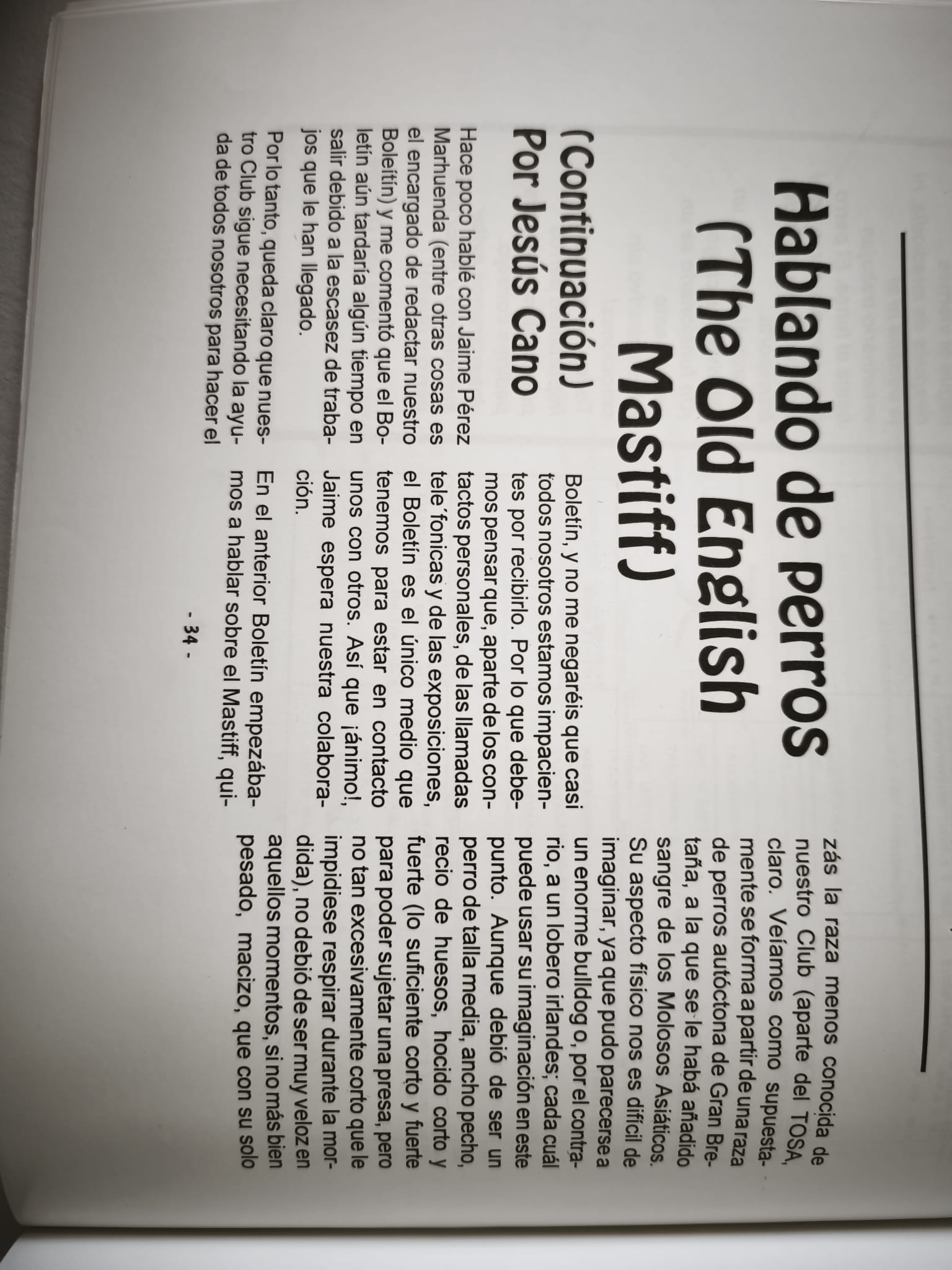
19th-century Bulldog. It can clearly be seen that the upper jaw has been forced backward with a piece of wood and a harness.
That is how I imagine the Mastiff of those times, and perhaps that is how William the Conqueror and his Normans found it when they defeated King Harold at the Battle of Hastings in 1066. There is a tapestry, attributed to Matilda, the wife of the Conqueror, known as the Bayeux Tapestry, in which King Harold appears with his falcon and dogs. Some consider that the larger dogs may have been Mastiffs, although, in the opinion of Douglas B. Oliff and my own, the dogs are too light to be considered Mastiffs. Perhaps Matilda was rather depicting the dogs brought by the Norman conquerors, which must have been descendants of the Alans that had accompanied the hordes of Vandals and Alans coming from the Caucasus regions, who swept across Europe and brought down the Roman Empire.
It is precisely to the Normans that we owe the name Mastiff to define this type of dog. It was not until that time that the word Mastiff appeared, taken from the Latin “mastivus”, meaning massive, and which in other countries, such as France, gave rise to the name Matin; in Spain, Mastín; and in Italy, Mastino. Before this period, and among the Saxons, the mastiff type was referred to and known as Ban-Dog, from band meaning chain, and dog, because of the custom of keeping dogs chained during the day and releasing them only at night.
The dog brought by the Normans must have been crossed with the Mastiffs of the period, resulting in a lighter animal, with a hunting instinct superior to that of our old Mastiff, capable of pursuing and killing the deer and stags that inhabited the forests of the nobility. This led, in the Forest Laws during the reign of Henry III, to the enactment of a rule allowing farmers and forest inhabitants to keep Mastiffs for the defense of their homes and properties, provided that they were expeditated by cutting off at the root the three claws of the front paw, placing it on a piece of wood eight inches thick, about 20 centimeters, by one square foot, about 30 centimeters, and with a chisel two or three inches wide, from 5 to 7 centimeters, they had to be cut off in a single blow.
This way of preventing the Mastiffs of the period from hunting the King’s deer gives us an idea that the Mastiff of that time could not have been as heavy as it is today, and perhaps as it had been during Roman colonization. Hence the possibility that it had been crossed with other similar dogs, perhaps the Alano, may have been possible.
During the reign of Henry V, the most widely told story about the Mastiff took place: that of Sir Peers Leigh, Lord of Lyme Hall.
On October 25, 1415, during the Battle of Agincourt, Sir Peers was mortally wounded and was protected from the enemy by his mastiff bitch throughout the night, being found by English soldiers the following morning. Sir Peers died in Paris and his body was sent to England together with his bitch, which had given birth to a litter of puppies.
Sir Peers was buried in the church of Macclesfield, and the mastiff bitch and her litter were kept by the family of Sir Peers at Lyme Hall, from which one of the oldest Mastiff bloodlines was established.
Regarding this story, Reverend M. B. Wynn, in his book “History of the Mastiff”, specifies the following:
“I must remind my readers that Henry V, with his army, weighed anchor from the port of Southampton on August 13, 1415, and the Battle of Agincourt took place on the following October 25, exactly 63 days having passed since Henry V’s army had put to sea. And since the bitch was able to take part in the battle and was sufficiently active to defend her master, not giving birth until some time after her arrival in Paris, it is evident that she must have come into heat after leaving England. Therefore, it is quite probable that great care was taken in choosing the father of the litter, so it is more likely that the line established at Lyme Hall was bastard from the very beginning.
I mention this because some authors, relying on the legend, have worked in vain trying to establish the purity of breed of this line, saying that the Lyme Hall line presented the correct type of English Mastiff (...)”.
Another period of influence for the Mastiff developed during the Tudor and Stuart eras.
During these periods, the Mastiff began to be used for the so-called “fighting sports” with bulls and bears. These spectacles reached their height during the reign of Elizabeth I.
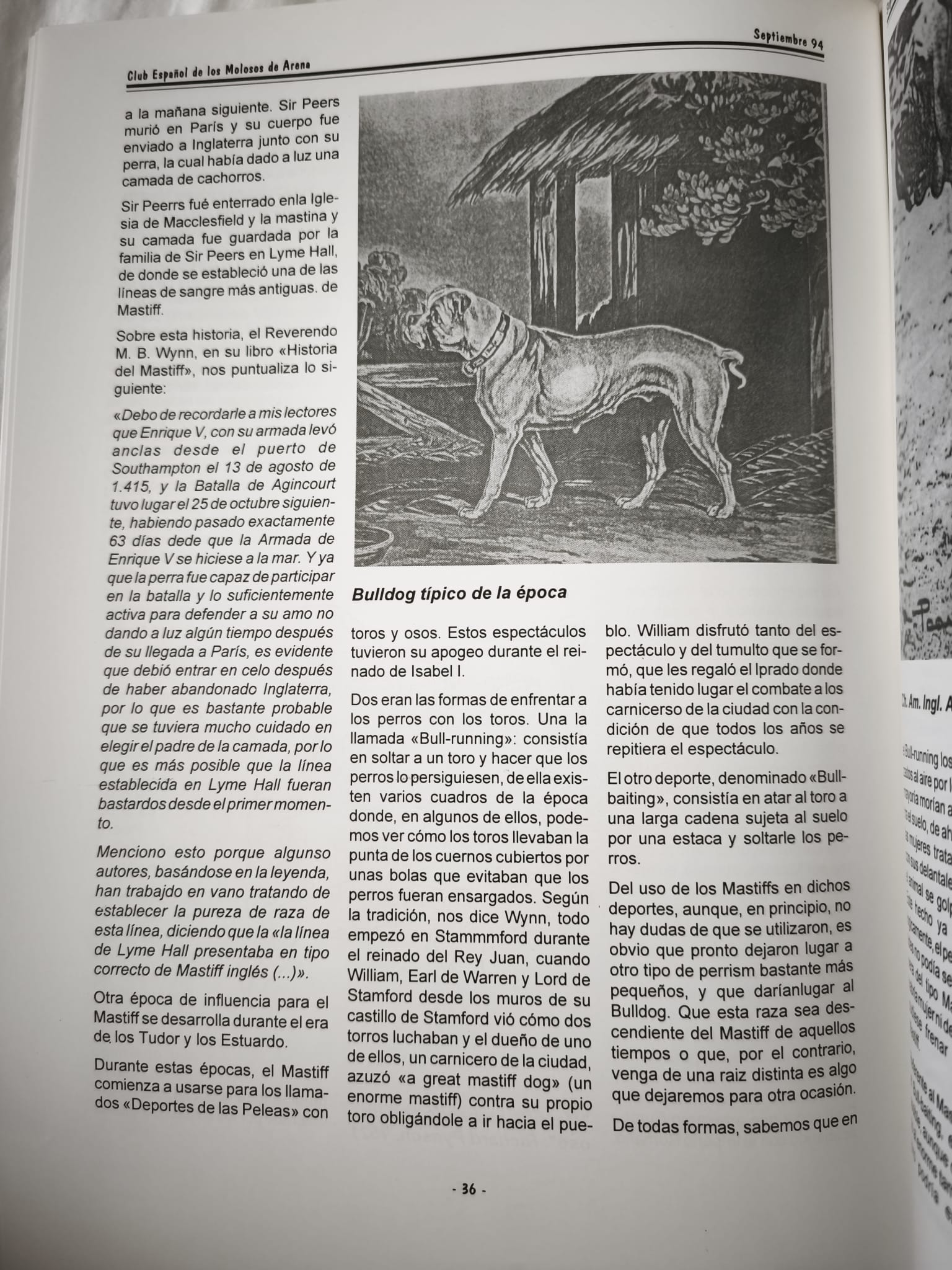
Typical Bulldog of the period.
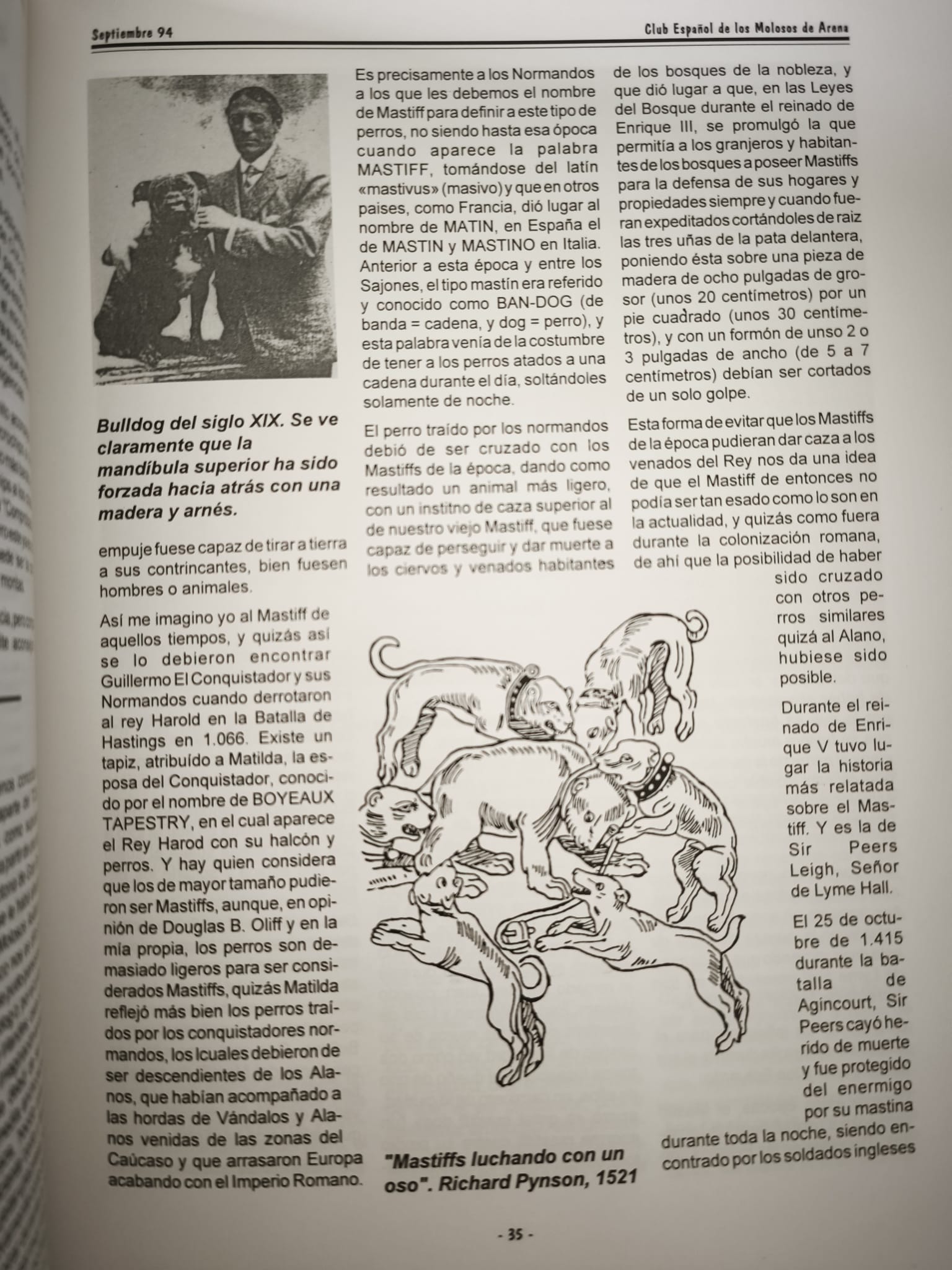
There were two ways of setting dogs against bulls. One was called bull-running: it consisted of releasing a bull and making the dogs chase it. There are several paintings from the period in which, in some of them, we can see how the bulls had the tips of their horns covered with balls to prevent the dogs from being gored. According to tradition, Wynn tells us, it all began in Stamford during the reign of King John, when William, Earl of Warren and Lord of Stamford, from the walls of his castle at Stamford, saw two bulls fighting, and the owner of one of them, a butcher from the town, set “a great mastiff dog” against his own bull, forcing it to go toward the town. William enjoyed the spectacle and the commotion that arose so much that he gave the meadow where the fight had taken place to the town’s butchers, on the condition that the spectacle be repeated every year.
The other sport, called bull-baiting, consisted of tying the bull to a long chain fixed to the ground by a stake and releasing the dogs on it.
Regarding the use of Mastiffs in these sports, although in principle there is no doubt that they were used, it is obvious that they soon gave way to another type of much smaller dog, which would give rise to the Bulldog. Whether this breed descends from the Mastiff of those times or, on the contrary, comes from a different root is something we will leave for another occasion.
In any case, we know that in bull-running the dogs were thrown into the air by the bulls, and that most died when they crashed against the ground. Hence it is said that women tried to catch them with their aprons to prevent the animal from hitting the ground. This fact already indicates to us that, logically, the dog used in those contests could in no way have been of the Mastiff type, since no woman or apron could have stopped the fall of a Mastiff.
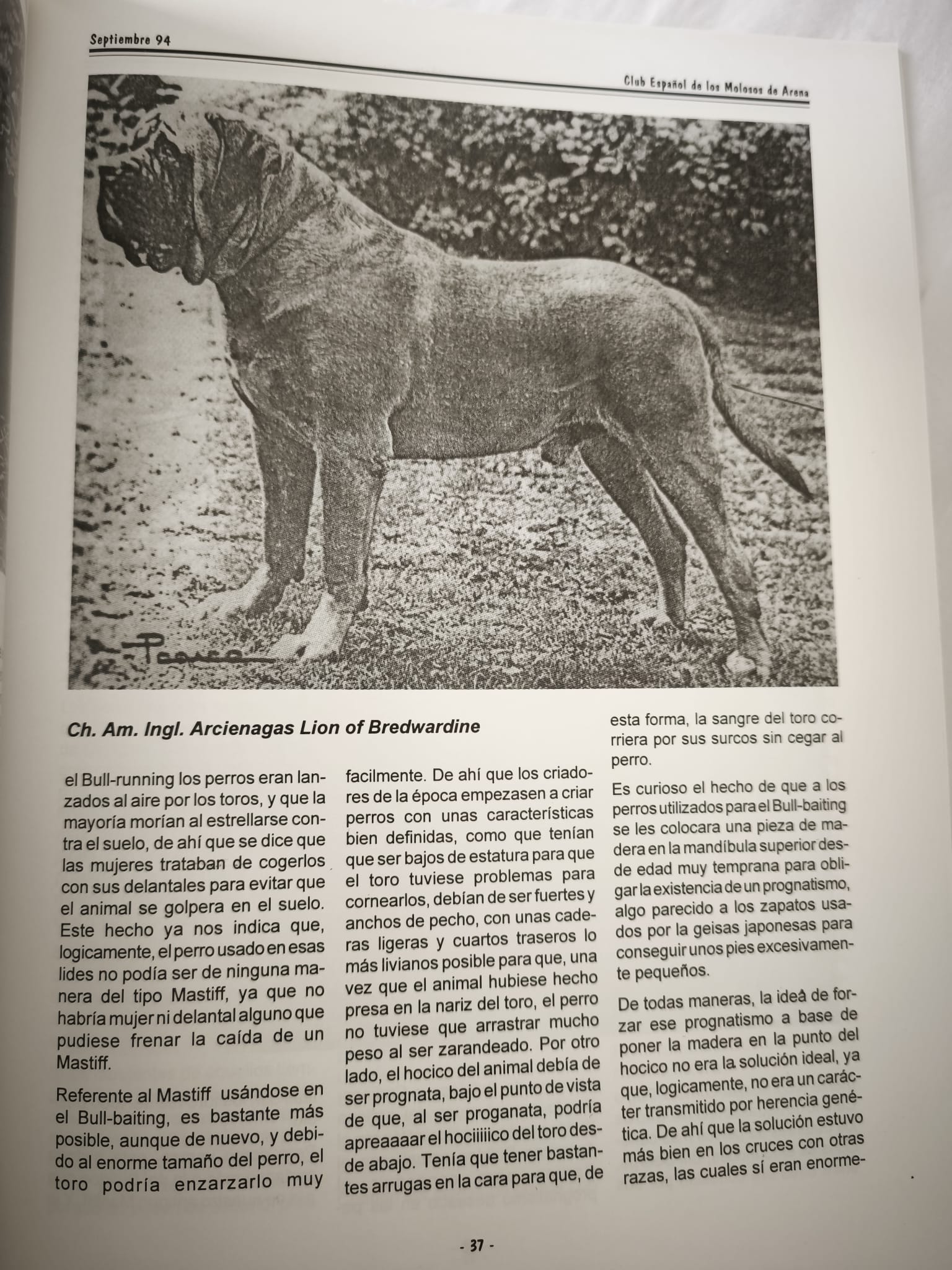
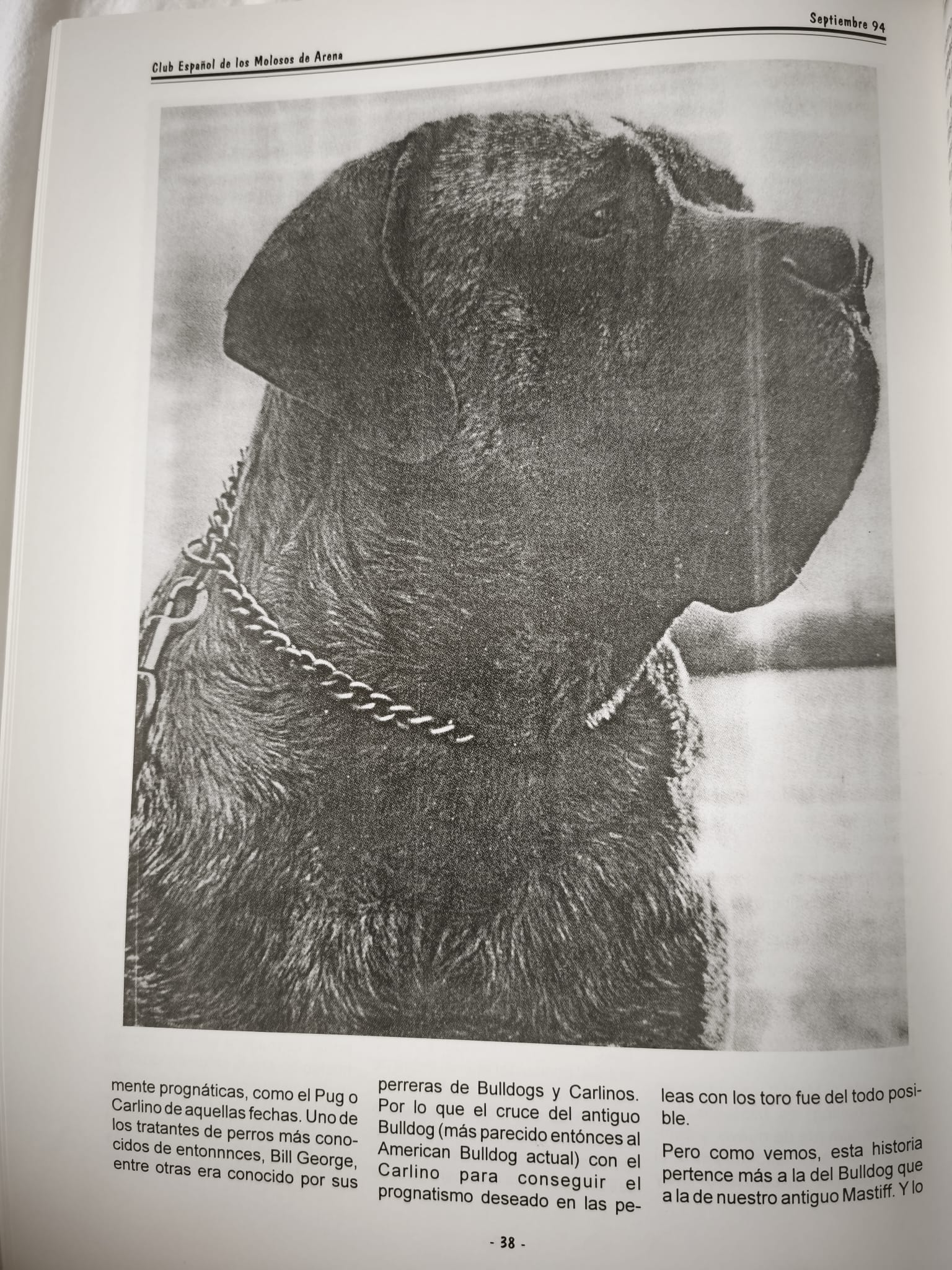
American and English Champion Arcienagas Lion of Bredwardine.
Regarding the Mastiff used in bull-baiting, this is much more possible, although again, because of the enormous size of the dog, the bull could catch it very easily. Hence the breeders of the period began to breed dogs with very defined characteristics: they had to be low in stature so that the bull would have difficulty goring them; they had to be strong and broad-chested, with light hips and hindquarters as light as possible so that, once the animal had seized the bull’s nose, the dog would not have to drag too much weight while being shaken. On the other hand, the animal’s muzzle had to be prognathous, from the point of view that, being prognathous, it could seize the bull’s muzzle from below. It had to have many wrinkles on the face so that the bull’s blood would run through its folds without blinding the dog.
It is curious that dogs used for bull-baiting had a piece of wood placed on the upper jaw from a very early age in order to force the existence of prognathism, something similar to the shoes used by Japanese geishas to obtain excessively small feet.
In any case, the idea of forcing this prognathism by placing wood on the tip of the muzzle was not the ideal solution, since, logically, it was not a trait transmitted by genetic inheritance. Hence the solution lay rather in crosses with other breeds that were indeed highly prognathous, such as the Pug or Carlino of those times. One of the best-known dog dealers of the period, Bill George, among other things, was known for his kennels of Bulldogs and Pugs. Therefore, the cross between the old Bulldog, then more similar to the current American Bulldog, and the Pug in order to obtain the desired prognathism for fights with bulls was entirely possible.
But as we can see, this history belongs more to the Bulldog than to our old Mastiff. And the same can be said of bear fights and dog fights.
In these, Mastiffs could indeed have been used, although little by little they gave way to other types of dogs.
Reverend M. B. Wynn, again in his book “History of the Mastiff”, tells us how bear and dog fights were carried out:
“A wooden stake, to which an iron ring was attached, was driven into the ground, where the unfortunate bear was tied, either with a chain or with a rope, the latter being more advisable. The bear was then deprived of its muzzle, and the bear dogs, not the Bulldogs, were chained around it at a prudent distance outside the bear’s reach. Then one, or preferably two, were released without any collar and, if they were well trained, went directly toward the bear, trying to throw it onto its back against the ground by their own force and seize it by the throat.”
Bear dogs are described to us, according to Mr. John Lyall of Glasgow, as dogs with a large head, short, broad and deep muzzle, bodies slightly lighter than those of Mastiffs but heavier than boarhounds, with a height of about 30 inches at the withers, about 76 centimeters, with strong bone, short hair and cropped ears.
However, in drawings from the period the dogs seem rather to be of the type of a Dogo Argentino, American Staffordshire or modern American Bulldog.
If the artists of those times had any idea of proportions, this makes us think that, although the Mastiff may have initially been used for fights with bears, it soon ceased to be used. Why, we cannot know; but as Mastiff lovers, we can dream of the theory that Mastiffs were too powerful, even for a bear, and ceased to be used because, if the Mastiff could kill a bear with some ease, the owners of the bears would not want to pit them against the enormous Mastiffs, and thus there would be no spectacle. This could be true if we give credit to the story that, during the reign of Elizabeth I of England in 1572, Lord Buckhurst, ambassador at the court of Charles IX of France, owned a Mastiff which, unaided, faced a bear, a leopard and a lion, defeating all three.
Another story showing that a good Mastiff could kill a bear, Wynn tells us, was demonstrated at St. Ann’s, south of Owram, near Halifax, in Yorkshire, around 1800.
A Mastiff bitch, owned by Mr. Thompson, was chained in the yard when a man travelling with an enormous and savage bear arrived at the house and, upon seeing the dog, was eager to have it attacked. The traveller offered the dog’s owner a shilling to fight them, and Mr. Thompson accepted. The bear was deprived of its muzzle and, as soon as the dog was unchained, she sprang upon the bear, avoiding its attack, throwing it to the ground and almost killing it before they could separate them amid the cries of the bear’s owner.
There are many stories like these which, if true, tell us not only of the ferocity of our Mastiff, but rather of the tremendous strength these animals must have possessed in the past.
Regarding dog fighting, we can see how, in principle, the use of enormous Mastiffs could have been entirely possible, but again here we ended up replacing them with much smaller dogs.
When dog fights with bears and bulls were declared illegal, dog fighting began to be promoted, so that, not being explicitly prohibited, it became something entirely legal.
Nevertheless, and despite the fact that the Mastiff could have been king, the number of dogs that had been created for fights against bulls and bears and stopped being used for their former “jobs” when those became illegal was quite large. Therefore, they were made to fight one another, turning the “sport” into something more attractive for the people of those times, since the lightness and mobility of those combatants gave the spectacle more duration and showiness.
But this was not the only thing that displaced the Mastiff from the fighting pits. The law again prohibited dog fighting. The punishments for owners became quite severe, and Mastiff breeders could not afford the luxury of being caught red-handed.
Thus a new type of dog began to be used. What was sought was the agility and mobility of a small-sized dog, combined with the fierceness, determination and bite of the presa dogs. They had to be small enough for their owners to carry them in their arms into the bars and inns where fights were practiced, which were practically all of them. There they could arrange a fight, and, in the event of a police alarm, the owners could easily take their dogs in their arms and run away. And thus the Staffordshire Bull Terrier was born.
But, as they say, that would be another story.
Frequently asked questions
What is the origin of the Old English Mastiff?
The Old English Mastiff is thought to have formed from native British dogs and Asian molossers, with Norman influence playing a significant role in its naming and early development.
What was the historical use of Mastiff-type dogs?
Historically, Mastiff-type dogs were used for hunting, defense, bull-running, bull-baiting, bear-baiting, and dog fighting. These practices also contributed to the development of breeds like the Bulldog.
What is the significance of the Lyme Hall bloodline?
The Lyme Hall bloodline is one of the oldest Mastiff bloodlines, established by the family of Sir Peers Leigh after his mastiff bitch protected him during the Battle of Agincourt and later gave birth to puppies.
How did the Mastiff's role change over time?
Initially used for heavy tasks and defense, Mastiffs were later involved in fighting sports. Over time, smaller breeds like the Bulldog emerged for these specific activities, while the Mastiff's role evolved.
What does the term 'Ban-Dog' refer to?
Before the term 'Mastiff' became common, the mastiff type was known as 'Ban-Dog' among the Saxons, derived from 'band' (chain) and 'dog', referring to the custom of keeping these dogs chained during the day and releasing them at night.
Related articles
Colors in the Molosos de Arena, September 1994
Author: Gilbert de Mulder Published in: “Club Español de los Molosos de Arena” Date: September 1994 English translation: artificial intelligence The article introduces a series dedicated to the genetics of coat color in the breeds grouped as Molosos de Arena. Gilbert de Mulder explains the basic functioning of genes and alleles related to coat color, focusing especially on the “S” locus and its influence on the appearance of white markings. The text analyzes specific cases in the Mastiff, Bullmastiff, Neapolitan Mastiff, Dogue de Bordeaux and Fila Brasileiro, defending the importance of studying pedigrees and breeding lines in order to avoid undesirable genetic combinations.
Colors in the Fila Brasileiro, July 1993
Published in: “Club Español de los Molosos de Arena” Date: July 1993 English translation: artificial intelligence The article addresses the controversy surrounding accepted colors in the Fila Brasileiro and defends the CAFIB position regarding the rejection of black as a correct color in the breed. Mar Olivas Tur argues that other colors and combinations, such as white, brindle, sand and cinza champagne, are part of the history and authenticity of the Fila. The text insists that the quality of a specimen should not be judged exclusively by the color of its coat, but by its correctness, typicity and racial value.
Tosa-Inu: the noble samurai
Author/commentary: D. Javier Sánchez Fernández, international judge Published in: “CLUB ESPAÑOL DE LOS MOLOSOS DE ARENA” magazine Date: 2000 English translation: artificial intelligence D. Javier Sánchez Fernández analyzes the Tosa-Inu from his experience as an international judge and expert on Japanese breeds. The article addresses the cultural value of the Tosa in Japan, its relationship with samurai tradition, its character as a ceremonial fighting dog, the difficulty of accessing authentic specimens outside Japan, and the risks of losing typicity when the breed is interpreted through Western show criteria. The importance of head, expression, mobility, temperament and preservation of racial identity is also emphasized.
The ideal age to breed the male and female Fila Brasileiro, April 1994
Author: Paulo Santos Cruz The article analyzes the reasons why CAFIB established restrictive rules regarding the minimum breeding age and the rest periods between litters in the Fila Brasileiro. Paulo Santos Cruz argues that sexual maturity is not the same as full physical maturity, especially in large and molossoid breeds. The author explains that breeding males and females too early can harm the health of the dogs, weaken selection, and compromise the quality of the breed. The article was published by Paulo Santos Cruz in the magazine “CLUB ESPAÑOL DE LOS MOLOSOS DE ARENA” in April 1994 and translated by artificial intelligence.
Dysplasia in the Dogue de Bordeaux, September 1994
Author: Dr. Fontaine Published in: “Club Español de los Molosos de Arena” Date: September 1994 Lecture: Saturday, 6/11/93 Spanish translation: P. Llorca English translation: artificial intelligence The article records a lecture by Dr. Fontaine on dysplasia in the Dogue de Bordeaux. The text addresses hereditary, environmental, nutritional and exercise-related factors that may influence the appearance or worsening of dysplasia. It also explains the importance of radiography, correct positioning of the dog, the first hip-reading statistics in the breed and the need to carry out controls before using dogs for breeding.
Dilated cardiomyopathy in molossers: symptoms, diagnosis and treatment
Author: Dr. Rosario Bergamín Published in: “CLUB ESPAÑOL DE LOS MOLOSOS DE ARENA” magazine Date: 2001 English translation: artificial intelligence Dr. Rosario Bergamín explains dilated cardiomyopathy in large dogs, especially molossers. The article describes its progressive nature, its possible genetic basis, the factors that may contribute to its development, its symptoms, diagnostic methods and treatment options. It also highlights the importance of periodic cardiac check-ups, especially before anesthesia or surgery, in order to detect the disease in early stages and improve survival.