
Colors in the Molosos de Arena, September 1994
Author: Gilbert de Mulder Published in: “Club Español de los Molosos de Arena” Date: September 1994 English translation: artificial intelligence The article introduces a series dedicated to the genetics of coat color in the breeds grouped as Molosos de Arena. Gilbert de Mulder explains the basic functioning of genes and alleles related to coat color, focusing especially on the “S” locus and its influence on the appearance of white markings. The text analyzes specific cases in the Mastiff, Bullmastiff, Neapolitan Mastiff, Dogue de Bordeaux and Fila Brasileiro, defending the importance of studying pedigrees and breeding lines in order to avoid undesirable genetic combinations.
By @a.myanimal
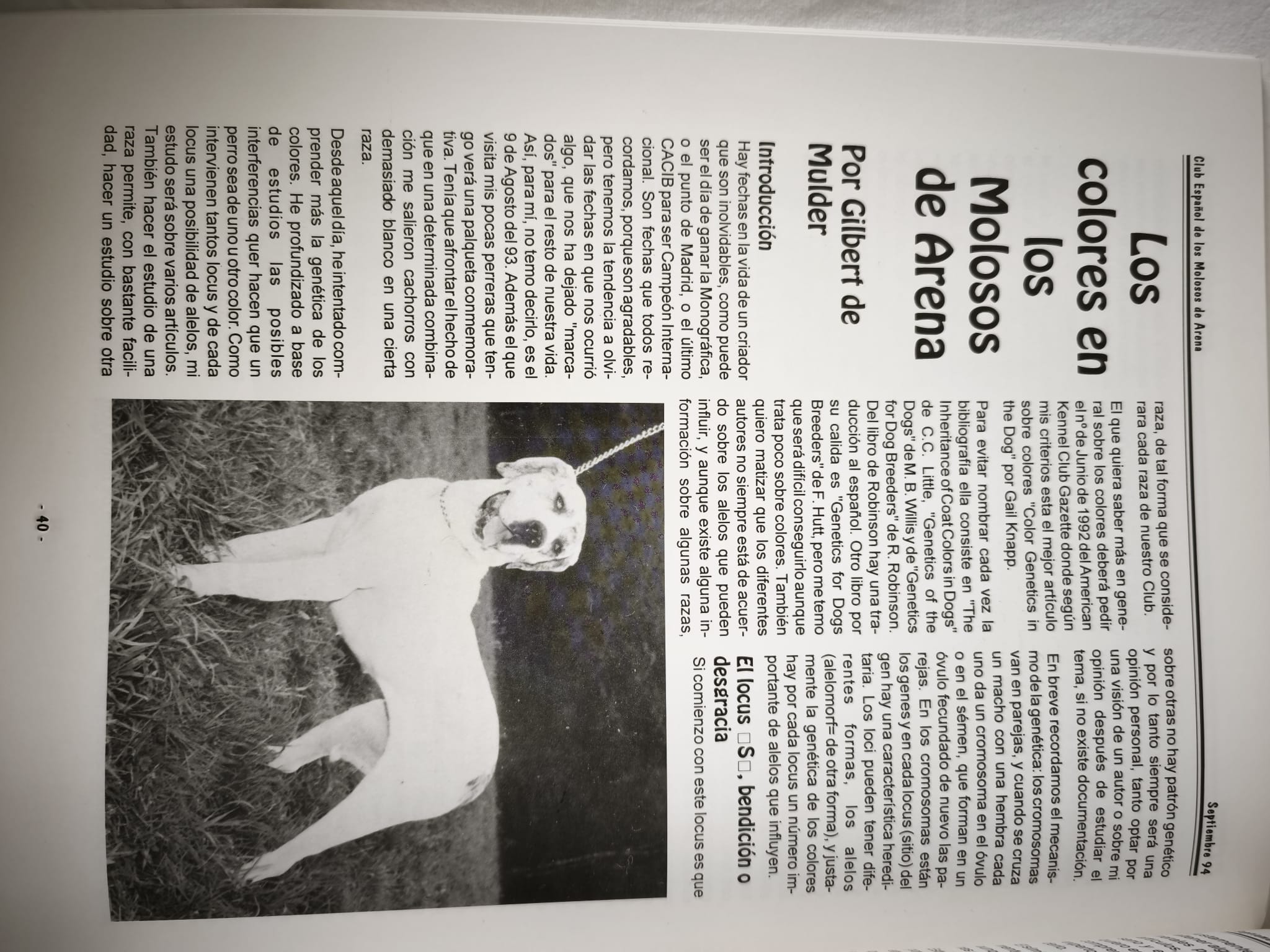
By Gilbert de Mulder
Introduction
There are dates in a breeder’s life that are unforgettable, such as the day of winning the Specialty Show, or the Madrid point, or the last CACIB needed to become International Champion. These are dates we all remember because they are pleasant, but we tend to forget the dates when something happened to us that left us “marked” for the rest of our lives. Thus, for me, I hardly need to say it, it is August 9, 1993. Moreover, anyone who visits the few kennels I have will see a commemorative plaque. I had to face the fact that, in a certain combination, puppies were born with too much white in a certain breed.
Since that day, I have tried to understand more about the genetics of colors. I have studied in depth the possible interferences that make a dog one color or another. Since so many loci are involved and, at each locus, there is a possibility of alleles, my study will be divided into several articles. Also, studying one breed allows, with considerable ease, the study of another breed, so each breed of our Club will be considered.
Anyone who wants to know more in general about colors should request the June 1992 issue of the American Kennel Club Gazette, where, in my opinion, the best article on colors appears: “Color Genetics in the Dog”, by Gail Knapp.
To avoid naming the bibliography each time, it consists of “The Inheritance of Coat Colors in Dogs” by C. C. Little, “Genetics of the Dogs” by M. B. Willis and “Genetics for Dog Breeders” by R. Robinson. Robinson’s book has a Spanish translation. Another book of great quality is “Genetics for Dog Breeders” by F. Hutt, but I fear it will be difficult to obtain, although it deals little with colors. I also want to point out that the different authors do not always agree on the alleles that may influence, and although there is some information on certain breeds, for others there is no genetic pattern and therefore it will always be a personal opinion, whether choosing the view of an author or my own opinion after studying the subject, if there is no documentation.
Briefly, let us recall the mechanism of genetics: chromosomes come in pairs, and when a male is crossed with a female, each one gives one chromosome in the ovum or in the semen, forming the pairs again in a fertilized ovum. The genes are located on the chromosomes, and at each locus, or place, of the gene there is a hereditary characteristic. The loci may have different forms, the alleles, allele = of another form, and precisely in color genetics there are, for each locus, a significant number of alleles that influence.
The “S” locus, blessing or misfortune
If I begin with this locus, it is because it was precisely the cause of my having some general knowledge from reading books and articles, and of my starting a more serious and in-depth study. I also want to write an article that can be understood without having to be an expert in genetics.
The symbol “S” stands for SELF, freely translated as single/autonomous, although sometimes in conversation “Solid” is used.
This locus, in many breeds such as the Boxer, the Dalmatian, etc., defines the proportion of white the dog has. Sometimes, as in the Samoyed, there is the presence of another locus, in this particular case the “C” locus, which accentuates white in the C(ch) allele. But none of these cases applies to the Molosos de Arena.
This locus has 4 alleles, that is, it can appear in 4 possibilities of importance regarding the presence of white, and they are, in order of dominance, the following:
S: Self, that is, entirely of the dog’s color, without any white marking, although some authors say that an “S” may have a tiny bit of white.
S(i): Irish, which are dogs with well-localized white markings on the chest and part of the abdomen, and on the tips of the feet. Some authors confirm that if there is white on the tip of the tail, it is no longer S(i).
S(p): Piebald, in which the markings may be found on the neck, face, back, up to above the tips of the feet, the so-called “socks”, and on the tail. A good example is the English Bulldog, half white and half colored, or the black and white French Bulldog.
S(w): White piebald, where white is already dominant, for example the Dalmatian, which is homozygous in S(w).
There is a rule we must have very clear: a white dog, and when we speak of the “A” locus this will be better understood, does NOT exist. All dogs have a color defined by the “A” locus, but it is the alleles of the “S” locus that define whether white is “put on”. Thus, a Dalmatian is NOT a white dog with some black spots, but a black dog, in this case A(s), but with S(w)S(w) at its “S” locus, which makes it white.
Study of each Molosser breed regarding the “S” locus
Mastiff: this is a very clear and simple case. The standard says that the dog must be of a single color, with mask, which means that in any case it is SS, since no other allele capable of producing white can interfere.
Bullmastiff: this is already somewhat more complicated. Breed purists do not want white, although the standard says that a “small” spot on the chest is permitted. Little and Willis consider it SS, while Robinson specifies nothing about the S locus in the Bullmastiff, only comparing it to the Boxer.
Where, then, does this “small” white spot permitted by the standard come from? It is a good example of how genetics explains history or confirms the “influences” at the beginning of the breed. Anyone who knows something about the Bullmastiff knows that it is a cross in which the Bulldog was used, I mean the old Bulldog such as Eva and Crib, which are completely different from the current Bulldog. If one looks at the “S” alleles in the Bulldog, one will notice that there are several possibilities: S(i), S(p), both recessive. The other breed was the Mastiff with dominant SS, and throughout the history of the Bullmastiff, preference has been given to dogs with as little white as possible. Therefore, although it is said to be SS, the Bullmastiff in very exceptional cases could still be Ss(i). There is also the theory that the “S” allele, in some exceptional breeds, would produce a small white spot; Little calls this “modifications plus” or “modifiers minus”.
Neapolitan Mastiff: according to the standard, it may have white on the chest and a little white on the tips of the feet. This means that the Neapolitan is S(i). In the disqualifications, and I have spoken with Miguel Brunel Jr., who had never seen the phenomenon, “white” is named as a defect. Since there is no pattern for the breed, I have compared it to the Great Dane to discover how white can appear even over the whole body if the dog is S(i). The answer is that the Mastino, at the “M” locus, can have MM, merle, which gives white markings invading the body or totally white dogs that, in many cases, are also deaf and blind, since the Mastino can be “blue”, which confirms the presence of M.
Dogue de Bordeaux: the standard mentions white on the chest and on the extremities of the feet. This means that the Bordeaux is a typical example of S(i). If we follow Little’s theory on the plus and minus modifiers, this can explain “socks” and, strictly speaking, a white tip on the tail and white on the neck. But here, once again, knowing something about the history of the breed can explain markings even on the body and face. The very famous and historic Caporal had white markings on the face and body. The question is: how, as in the Bullmastiff, is it possible to have, alongside S(i) as normal, the presence of S(p) in some cases, producing dogs S(i)s(p)? Kunstler mentions ancient crosses, as in the Bullmastiff, with Bulldogs, which are positively carriers of S(i), S(p) and, in some cases, S(w).
This may be an acceptable hypothesis, but there is one more possibility that seems worthy of consideration. The region of Bordeaux, being next to Spain, makes it not foolish to suppose that some Spanish Dogos went to France for bull games, as Goya depicts in his engravings. Because of geographical location, size, character and use, it is very likely that some crosses of Dogues de Bordeaux were made with Spanish Dogos, which were certainly crossed with English Bulldogs and, as the engravings show, have everything to be S(i), S(p) and in some cases S(w).
Selection has eliminated as much white as possible, but from what I have personally seen, I can confirm with near certainty that the recessive S(p) still remains in some specimens.
But it is very dangerous to generalize from one’s own experience. Tomás Pinto confirmed the phenomenon to me and also knew of a litter with excess white. Alfonso Curet also confirmed to me that in some crosses he had had so much white that, from his comments, one may suspect the presence of S(p). On the other hand, a French breeder confirmed to me that in a certain combination, similar to mine, he had had puppies with white markings on the body. There is no doubt: for me, the S(p) locus/allele is still present in the Dogue de Bordeaux.
Fila Brasileiro: it is very similar in its white markings to the Dogue de Bordeaux. Excess white is penalizable. But there are Filas that are clearly S(p), recessive, demonstrating that the “p” allele may be present. There is no doubt: anyone who knows a little about the history of the Fila knows that it has been crossed with several breeds that are positively carriers of S(p) and S(w). Selection has eliminated white as much as possible, but it is perfectly possible that some specimens remain carriers of S(p) at least. Since it is a gene recessive to S(i), only bad luck can combine two carriers producing S(p)S(p).
I allow myself to translate a comment that Inés Van Damme sent me: “There is a difference between the CAFIB and CBKC standards. White color has always been present in the Fila. There are Filas that are totally white with brindle markings and unicolor or brindle Filas that show a lot of white, white all around the neck, the muzzle... The CBKC standard accepts only 1/4 of the body with white in the year 1984, and this without prior notice, in order to achieve better homogeneity (...)”
Therefore, the Fila is positively a carrier of S(i), S(p) and, according to what Inés says, probably in some exceptions still a carrier of S(w) as regards CAFIB dogs.
A study task for a Club with “genetic” awareness
In a discussion about white with a prestigious breeder of “many years”, I, feeling like a neophyte, was told textually: “It is simple, the fault lies with the father of the litter”, a demonstration of complete ignorance of what genetics and line planning are. It is NOT the father; it is the grandparents, the great-grandparents that must be looked at. I do not want to give any example, so we avoid controversy, but a well-done study can indicate which dog introduced an allele. It is a matter of honesty and study what dog “X” has produced and what its descendants produce.
Unfortunately, many breeders are still not investigating lines and, instead of seriously searching pedigrees, simply ignore the facts or blame others. Serious follow-up and study can only help avoid joining possible carriers of a “harmful” recessive.
A piece of advice: we know that S is dominant over S(i), which in turn is dominant over S(p), etc., which means that when Filas with a great deal of white appear, we can assume that both the father and the mother, although of normal phenotype, are carriers of the recessive gene, which must be homozygous in order to manifest itself. Also, in some cases, it is impossible to say whether the dog is S(i) or doubtfully S(p); there is no measurement table, and this, of course, if the dog is S(i)s(p). Finally, inbreeding reinforces recessive genes. In other words, if a dog “X” appears very closely related to both parents, the strength of S(p), for example, increases and can produce S(i)S(p) dogs in its offspring, even though the phenotype of both parents is apparently S(i)S(i).
With thanks to Tomás Pinto, Alfonso Curet and Inés Van Damme, p.o.d.a..
Frequently asked questions
What is the S locus in dog coat color genetics?
The S locus, standing for SELF, influences the presence and proportion of white markings on a dog's coat. It has four main alleles: S (self-color), S(i) (Irish spotting), S(p) (piebald), and S(w) (white piebald).
How does the S locus affect breeds like the Dogue de Bordeaux or Fila Brasileiro?
In breeds like the Dogue de Bordeaux and Fila Brasileiro, the S locus can explain the presence of white markings on the chest, extremities, or even larger areas. While standards aim to limit white, recessive alleles like S(p) can still be present due to historical breed crosses.
Why is studying pedigrees important for coat color genetics?
Studying pedigrees is crucial for understanding coat color genetics. It helps breeders identify which ancestors introduced specific alleles, especially recessive ones, and avoid undesirable genetic combinations that lead to excessive white markings.
Can a dog be truly white?
According to the article, a dog is never truly white. All dogs have an underlying color determined by loci like the 'A' locus. The alleles at the 'S' locus then determine whether white 'covers' or masks that base color.
Related articles
Mastiff, Bullmastiff, Fila Brasileiro, Dogue de Bordeaux and Neapolitan Mastiff: together, but not mixed, February 1997
Author: J. M. Castillo Published in: “Club Español de los Molosos de Arena” Date: February 1997 Original translation: not indicated in the article English translation: artificial intelligence The article analyzes the morphological, historical and functional differences between several molossoid breeds included within the group known as “Molosos de Arena”. J. M. Castillo focuses especially on the Mastiff and compares it with the Bullmastiff, the Fila Brasileiro, the Neapolitan Mastiff and the Dogue de Bordeaux. The author warns against confusion between breeds, the indiscriminate use of crosses, the exaggerated search for size and the tendency to justify modern breeds through imprecise historical references. His main thesis is that these breeds may be related, but they must preserve their identity, type and specific characteristics.
Colors in the Fila Brasileiro, July 1993
Published in: “Club Español de los Molosos de Arena” Date: July 1993 English translation: artificial intelligence The article addresses the controversy surrounding accepted colors in the Fila Brasileiro and defends the CAFIB position regarding the rejection of black as a correct color in the breed. Mar Olivas Tur argues that other colors and combinations, such as white, brindle, sand and cinza champagne, are part of the history and authenticity of the Fila. The text insists that the quality of a specimen should not be judged exclusively by the color of its coat, but by its correctness, typicity and racial value.
The ideal age to breed the male and female Fila Brasileiro, April 1994
Author: Paulo Santos Cruz The article analyzes the reasons why CAFIB established restrictive rules regarding the minimum breeding age and the rest periods between litters in the Fila Brasileiro. Paulo Santos Cruz argues that sexual maturity is not the same as full physical maturity, especially in large and molossoid breeds. The author explains that breeding males and females too early can harm the health of the dogs, weaken selection, and compromise the quality of the breed. The article was published by Paulo Santos Cruz in the magazine “CLUB ESPAÑOL DE LOS MOLOSOS DE ARENA” in April 1994 and translated by artificial intelligence.
Dysplasia in the Dogue de Bordeaux, September 1994
Author: Dr. Fontaine Published in: “Club Español de los Molosos de Arena” Date: September 1994 Lecture: Saturday, 6/11/93 Spanish translation: P. Llorca English translation: artificial intelligence The article records a lecture by Dr. Fontaine on dysplasia in the Dogue de Bordeaux. The text addresses hereditary, environmental, nutritional and exercise-related factors that may influence the appearance or worsening of dysplasia. It also explains the importance of radiography, correct positioning of the dog, the first hip-reading statistics in the breed and the need to carry out controls before using dogs for breeding.
Round table around judge Bill Warren
Author: Begoña Pascua Interviewee: Bill Warren Published in: 2000 English translation: artificial intelligence The article records a round table with judge Bill Warren about the Bullmastiff. Through questions and answers, it discusses key aspects of the breed such as bite, prognathism, mask, ears, bone, movement, dysplasia, temperament, family breeding versus large-kennel breeding, and the difference between English and American lines. The text stresses the importance of always judging the dog as a whole, preserving breed type and breeding with common sense.
Versatility in the Fila Brasileiro, July 1993
Author: Clelia Kruel Drawing: Camburi do Embrema Published in: “Club Español de los Molosos de Arena” Date: July 1993 English translation: artificial intelligence The article presents the Fila Brasileiro as a breed deeply linked to Brazil’s rural history and highlights its versatility as a guard dog, hunting dog, companion and working dog. Clelia Kruel reviews its evolution from the Brazilian countryside to the cities, its international recognition and its role as a utility dog under extreme conditions, especially in tests carried out in the Amazon jungle. The text emphasizes its rusticity, endurance, sense of smell, strength, temperament and silent guarding ability.