
Versatility in the Fila Brasileiro, July 1993
Author: Clelia Kruel Drawing: Camburi do Embrema Published in: “Club Español de los Molosos de Arena” Date: July 1993 English translation: artificial intelligence The article presents the Fila Brasileiro as a breed deeply linked to Brazil’s rural history and highlights its versatility as a guard dog, hunting dog, companion and working dog. Clelia Kruel reviews its evolution from the Brazilian countryside to the cities, its international recognition and its role as a utility dog under extreme conditions, especially in tests carried out in the Amazon jungle. The text emphasizes its rusticity, endurance, sense of smell, strength, temperament and silent guarding ability.
By @a.myanimal
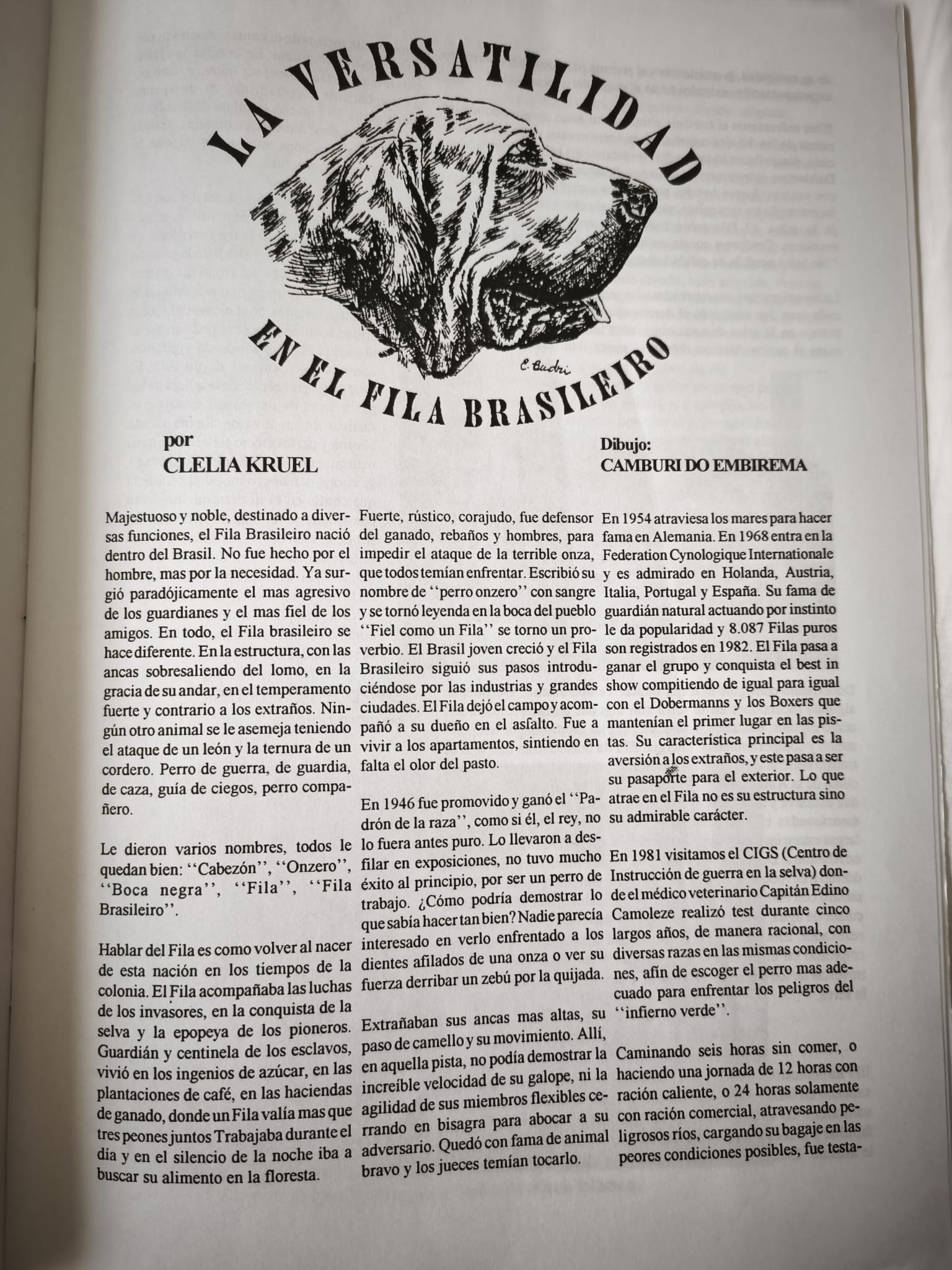
By CLELIA KRUEL.
Drawing: CAMBURI DO EMBREMA
Majestic and noble, destined for various functions, the Fila Brasileiro was born within Brazil. It was not made by man, but by necessity. And, paradoxically, there emerged the most aggressive of guardians and the most faithful of friends. In everything, the Fila Brasileiro is different. In its structure, with the hips standing out above the back; in the grace of its gait; in its strong temperament and hostility toward strangers. No other animal resembles it, having the attack of a lion and the tenderness of a lamb. War dog, guard dog, hunting dog, guide dog, companion dog.
It was given several names, all of which suit it well: “Big Head”, “Jaguar Dog”, “Black Mouth”, “Fila”, “Fila Brasileiro”.
To speak of the Fila is like returning to the birth of this nation in colonial times. The Fila accompanied the struggles of the invaders, in the conquest of the jungle and the epic of the pioneers. Guardian and sentinel of slaves, it lived in the sugar mills, in the coffee plantations, on the cattle farms, where one Fila was worth more than three farmhands together. It worked during the day and, in the silence of the night, went to seek its food in the forest.
Strong, rustic, courageous, it defended cattle, herds and men, preventing the attack of the terrible jaguar, which everyone feared facing. It wrote its name as a “jaguar-hunting dog” in blood and became a legend in the mouth of the people. “Faithful as a Fila” became a proverb. The young Fila grew, and the Fila Brasileiro followed its steps, entering industries and large cities. The Fila left the countryside and accompanied its owner on the asphalt. It went to live in apartments, missing the smell of pasture.
In 1946 it was promoted and received the “Breed Standard”, as if it, the king, had not already been pure before. It was taken to parade in shows; it did not have much success at first, being a working dog. How could it demonstrate what it knew how to do so well? No one seemed interested in seeing it face the sharp teeth of a jaguar or in seeing its strength bring down a zebu by the jaw.
Its higher hips, its camel-like pace and its movement seemed strange. There, in that ring, it could not demonstrate the incredible speed of its gallop, nor the agility of its flexible limbs closing like a hinge to seize its opponent. It gained a reputation as a fierce animal, and judges were afraid to touch it.
In 1954 it crossed the seas to make its name in Germany. In 1968 it entered the Fédération Cynologique Internationale and was admired in Holland, Austria, Italy, Portugal and Spain. Its reputation as a natural guardian, acting by instinct, gave it popularity, and 8,087 pure Filas were registered in 1982. The Fila began to win the group and achieved best in show, competing on equal terms with the Dobermann and the Boxers, which held first place in the rings. Its main characteristic is aversion to strangers, and this became its passport abroad. What attracts people to the Fila is not its structure, but its admirable character.
In 1981 we visited the CIGS, the Jungle Warfare Training Center, where veterinary doctor Captain Edinho Camoleze carried out tests for five long years, in a rational manner, with different breeds under the same conditions, in order to choose the dog most suitable to face the dangers of the “green hell”.
Walking six hours without eating, or doing a 12-hour journey with hot rations, or 24 hours only with commercial rations, crossing dangerous rivers, carrying its baggage in the worst possible conditions, the rusticity, endurance and nervous system of the dogs under experimentation were tested, demanding from them up to the point of exhaustion.
They faced simulated combat in wild areas where the branches of ancient trees intertwined, darkening the sky, where it rains every day, flooding the improvised trails. They injured themselves among walls of lianas. They passed through snakes and swamps with alligators, were wounded by thorns and punished by the incessant attack of mosquitoes, enduring the humid and suffocating heat of the jungle. The Fila survived. Its performance was considered excellent. As stated in Captain Camoleze’s reports: “There was no loss of quality or characteristics.”
The investigation and its results. Investigating the characteristics of each breed, the performance of each one in relation to jungle work was analyzed over five years. Intelligence: among the three breeds, the German Shepherd obtained the best index. Aggressiveness: the Dobermann achieved the best index. Temperament: after several incursions into the jungle with natural obstacles such as thorns, swamps, lianas, etc., the Fila showed better temperament and behavior. Energy: the Fila Brasileiro obtained the best index in this type of work, highlighting the importance of the Amazon climate in this aspect: high temperature, excessive humidity and a saturated atmosphere. Endurance: among the three breeds mentioned, the Fila showed the best aptitude, mainly during long stays in the jungle. Its exhaustion index is very low in relation to the Dobermann and the German Shepherd. Rusticity: in the jungle, due to its robustness, bone development and thicker skin, the Fila proved to be more rustic. Strength: mainly when crossing watercourses, the Fila dog revealed excellent qualities in the tests carried out. This animal, because of its physical capacity, can even be used to transport packages and small loads when crossing watercourses, either alone or assisting the combatant in the jungle.
Silent combatant
The Fila proved to be an excellent tracker inside the closed jungle, going out in search of survivors. Calm and tranquil, naturally vigilant, it does not bark or become easily frightened. The jungle seems familiar to it, and the sensation of danger searching through the darkness does not scare it. An excellent patrol dog, it detects and alerts to an ambush at about thirty meters’ distance, aided by its extraordinary sense of smell. In the jungle, the maximum vision reached by a human being, that is, by a specialized combatant, is barely ten meters. The Fila, with its developed sense of smell, helps to discover hidden tunnels, snipers, ambushes, etc., before the patrol is discovered.
Thus it increases the operational strength of the combatant, saving fuel, ammunition and, above all, lives. The jungle guerrilla dog is of incalculable value for guarding strategic points on distant borders. An ammunition depot, or other various types of supplies, in the middle of the jungle, in the total darkness of night, could be an easy target if it were not for the constant and silent vigilance of a Fila. It knows how to distinguish the fall of a leaf from the light steps of a wild animal or the trail of an invader. It growls to give the alarm and goes directly toward the target, neutralizing the aggression. Its strength and courage give moral support to the sentry, who trusts the discernment of his surveillance companion. The life of the regiment and the guarding of the ammunition depend on them. Especially at night, the dog completes human deficiency in hearing, smell and vision, which lose not only in quality but also in intensity when compared with the developed senses of the dog.
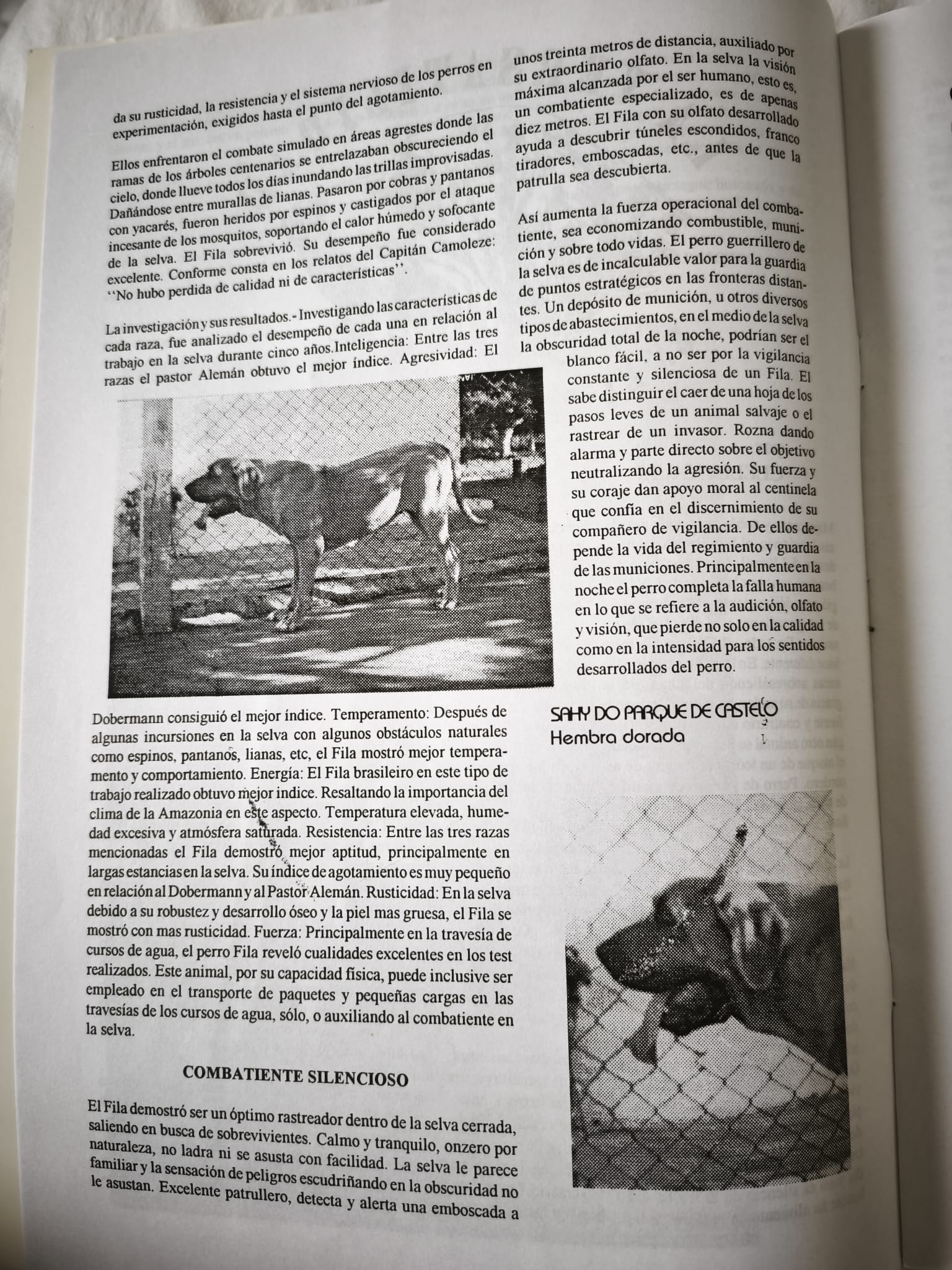
Sahy do parque de castelo
Golden female
Frequently asked questions
What are the key characteristics of the Fila Brasileiro?
The Fila Brasileiro is known for its rusticity, endurance, strong sense of smell, strength, unique temperament, silent guarding ability, and aversion to strangers.
How was the Fila Brasileiro tested in extreme conditions?
The Fila Brasileiro underwent rigorous tests at the Jungle Warfare Training Center (CIGS), enduring long journeys, harsh weather, and dangerous environments to assess its rusticity, endurance, and temperament.
What roles has the Fila Brasileiro historically played?
Historically, the Fila Brasileiro has served as a guard dog, hunting dog (especially for jaguars), companion dog, and working dog, integral to Brazil's rural history and pioneer struggles.
Why did the Fila Brasileiro initially struggle in dog shows?
The Fila Brasileiro struggled in early dog shows because its working abilities, such as facing jaguars or bringing down cattle, could not be demonstrated in a show ring environment, and its unique physical traits were considered strange.
Related articles
Colors in the Fila Brasileiro, July 1993
Published in: “Club Español de los Molosos de Arena” Date: July 1993 English translation: artificial intelligence The article addresses the controversy surrounding accepted colors in the Fila Brasileiro and defends the CAFIB position regarding the rejection of black as a correct color in the breed. Mar Olivas Tur argues that other colors and combinations, such as white, brindle, sand and cinza champagne, are part of the history and authenticity of the Fila. The text insists that the quality of a specimen should not be judged exclusively by the color of its coat, but by its correctness, typicity and racial value.
The ideal age to breed the male and female Fila Brasileiro, April 1994
Author: Paulo Santos Cruz The article analyzes the reasons why CAFIB established restrictive rules regarding the minimum breeding age and the rest periods between litters in the Fila Brasileiro. Paulo Santos Cruz argues that sexual maturity is not the same as full physical maturity, especially in large and molossoid breeds. The author explains that breeding males and females too early can harm the health of the dogs, weaken selection, and compromise the quality of the breed. The article was published by Paulo Santos Cruz in the magazine “CLUB ESPAÑOL DE LOS MOLOSOS DE ARENA” in April 1994 and translated by artificial intelligence.
Colors in the Molosos de Arena, September 1994
Author: Gilbert de Mulder Published in: “Club Español de los Molosos de Arena” Date: September 1994 English translation: artificial intelligence The article introduces a series dedicated to the genetics of coat color in the breeds grouped as Molosos de Arena. Gilbert de Mulder explains the basic functioning of genes and alleles related to coat color, focusing especially on the “S” locus and its influence on the appearance of white markings. The text analyzes specific cases in the Mastiff, Bullmastiff, Neapolitan Mastiff, Dogue de Bordeaux and Fila Brasileiro, defending the importance of studying pedigrees and breeding lines in order to avoid undesirable genetic combinations.
Mastiff, Bullmastiff, Fila Brasileiro, Dogue de Bordeaux and Neapolitan Mastiff: together, but not mixed, February 1997
Author: J. M. Castillo Published in: “Club Español de los Molosos de Arena” Date: February 1997 Original translation: not indicated in the article English translation: artificial intelligence The article analyzes the morphological, historical and functional differences between several molossoid breeds included within the group known as “Molosos de Arena”. J. M. Castillo focuses especially on the Mastiff and compares it with the Bullmastiff, the Fila Brasileiro, the Neapolitan Mastiff and the Dogue de Bordeaux. The author warns against confusion between breeds, the indiscriminate use of crosses, the exaggerated search for size and the tendency to justify modern breeds through imprecise historical references. His main thesis is that these breeds may be related, but they must preserve their identity, type and specific characteristics.
Tosa-Inu: the noble samurai
Author/commentary: D. Javier Sánchez Fernández, international judge Published in: “CLUB ESPAÑOL DE LOS MOLOSOS DE ARENA” magazine Date: 2000 English translation: artificial intelligence D. Javier Sánchez Fernández analyzes the Tosa-Inu from his experience as an international judge and expert on Japanese breeds. The article addresses the cultural value of the Tosa in Japan, its relationship with samurai tradition, its character as a ceremonial fighting dog, the difficulty of accessing authentic specimens outside Japan, and the risks of losing typicity when the breed is interpreted through Western show criteria. The importance of head, expression, mobility, temperament and preservation of racial identity is also emphasized.
Dysplasia in the Dogue de Bordeaux, September 1994
Author: Dr. Fontaine Published in: “Club Español de los Molosos de Arena” Date: September 1994 Lecture: Saturday, 6/11/93 Spanish translation: P. Llorca English translation: artificial intelligence The article records a lecture by Dr. Fontaine on dysplasia in the Dogue de Bordeaux. The text addresses hereditary, environmental, nutritional and exercise-related factors that may influence the appearance or worsening of dysplasia. It also explains the importance of radiography, correct positioning of the dog, the first hip-reading statistics in the breed and the need to carry out controls before using dogs for breeding.