
Mastiff, Bullmastiff, Fila Brasileiro, Dogue de Bordeaux and Neapolitan Mastiff: together, but not mixed, February 1997
Author: J. M. Castillo Published in: “Club Español de los Molosos de Arena” Date: February 1997 Original translation: not indicated in the article English translation: artificial intelligence The article analyzes the morphological, historical and functional differences between several molossoid breeds included within the group known as “Molosos de Arena”. J. M. Castillo focuses especially on the Mastiff and compares it with the Bullmastiff, the Fila Brasileiro, the Neapolitan Mastiff and the Dogue de Bordeaux. The author warns against confusion between breeds, the indiscriminate use of crosses, the exaggerated search for size and the tendency to justify modern breeds through imprecise historical references. His main thesis is that these breeds may be related, but they must preserve their identity, type and specific characteristics.
By @a.myanimal
By J. M. Castillo
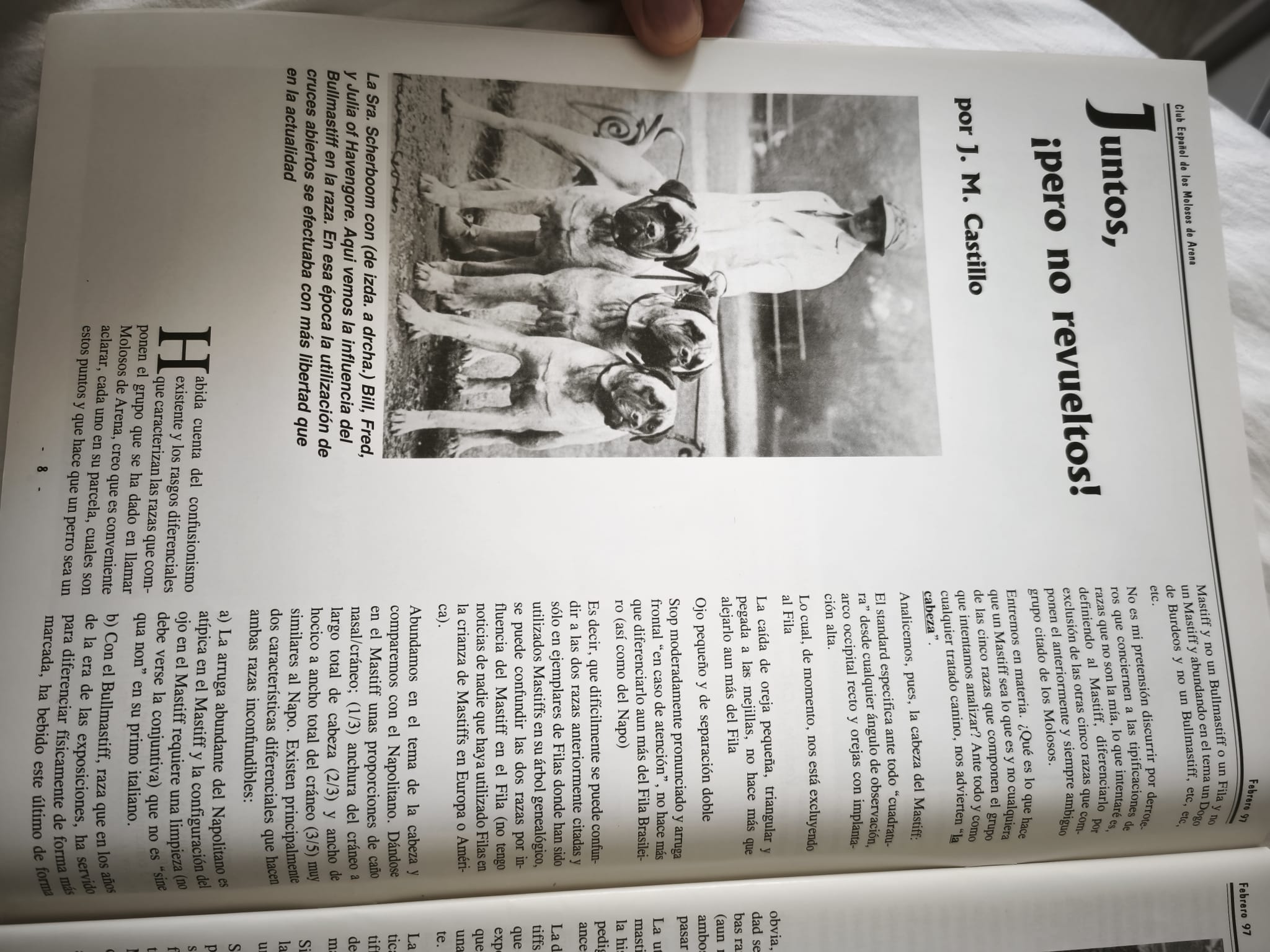
Mrs. Scherboon with, from left to right, Bill, Fred and Julia of Havengore. Here we see the influence of the Bullmastiff in the breed. At that time, the use of open crosses was carried out with more freedom than today.
Given the existing confusion and the differential traits that characterize the breeds that make up the group that has come to be called Molosos de Arena, I believe it is convenient to clarify, each within its own field, what these points are and what makes a dog a Mastiff and not a Bullmastiff, or a Fila and not a Mastiff, and, continuing with the subject, a Dogue de Bordeaux and not a Bullmastiff, etc., etc., etc.
It is not my intention to wander into matters concerning the typification of breeds that are not mine. What I will try to do is, by defining the Mastiff, to differentiate it by exclusion from the other five breeds that make up the previously and always ambiguous group of Molossers.
Let us get into the matter. What is it that makes a Mastiff what it is and not any of the five breeds that make up the group we are trying to analyze? Above all, and as any canine treatise warns us: “the head”.
Let us therefore analyze the head of the Mastiff:
The standard specifies above all “squareness” from any angle of observation, a straight occipital arch and high-set ears.
This, for the moment, excludes the Fila.
The fall of the small, triangular ear, close to the cheeks, only distances it even further from the Fila.
Small eyes with double separation.
A moderately pronounced stop and frontal wrinkle “in case of attention” only differentiate it even more from the Fila Brasileiro, as well as from the Napo.
That is to say, it is difficult to confuse the two aforementioned breeds, and only in specimens of Filas where Mastiffs have been used in their family tree can the two breeds be confused due to the influence of the Mastiff in the Fila. I have no news of anyone having used Filas in the breeding of Mastiffs in Europe or America.
Let us go further into the subject of the head and compare it with the Neapolitan. In the Mastiff, there are proportions of muzzle/cranium of 1/1; width of the cranium to total length of head, 2/3; and width of muzzle to total width of the cranium, 3/5, very similar to the Napo. There are mainly two differential characteristics that make both breeds unmistakable:
a) The abundant wrinkle of the Neapolitan is atypical in the Mastiff, and the configuration of the eye in the Mastiff requires cleanness; the conjunctiva must not be visible, which is not a “sine qua non” in its Italian cousin.
b) With the Bullmastiff, a breed that in the years of the show era has served to differentiate physically in a more marked way, the latter has obviously had to do so, to the point that even today one can observe specimens of both breeds that could pass for the opposite one. I still vividly remember two Bullmastiffs, both Spanish champions, that could perfectly pass for Mastiffs.
The common use of Mastiffs and Bullmastiffs in bastard crosses was common in the history of both breeds, and it is usual to see pedigrees of specimens up to 1945 with common ancestors in both breeds.
The differentiation between Mastiffs and Bullmastiffs was at certain moments more formal than factual. We read in some show reports from the beginning of the century about dogs that were presented as Mastiffs in one show and as Bullmastiffs in the next.
The length of the trunk would be another characteristic that differentiates the Mastiff from the Bullmastiff. The former is a rectangular dog, that is, with an elongated trunk, while the Bullmastiff is a more square dog.
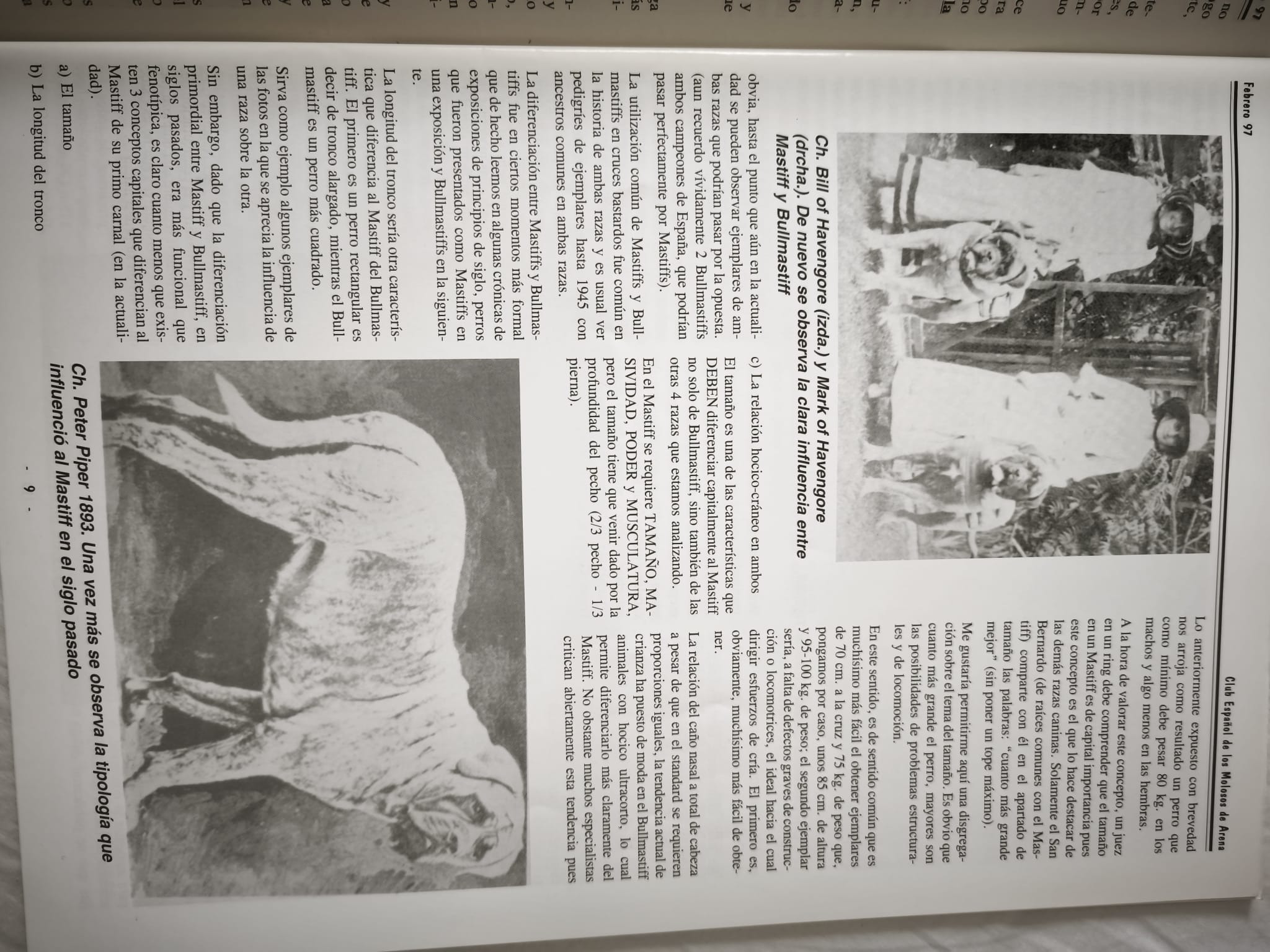
Let some of the specimens in the photos serve as examples, where the influence of one breed over the other can be appreciated.
However, since the primary differentiation between Mastiff and Bullmastiff in past centuries was more functional than phenotypic, it is at least clear that there are three essential concepts that differentiate the Mastiff from its close cousin today:
a) Size.
b) Length of the trunk.
c) The muzzle-skull relationship in both.
Ch. Bill of Havengore, left, and Mark of Havengore, right. Once again, the clear influence between Mastiff and Bullmastiff can be observed.
Size is one of the characteristics that MUST fundamentally differentiate the Mastiff not only from the Bullmastiff, but also from the other four breeds we are analyzing.
In the Mastiff, SIZE, MASSIVENESS, POWER and MUSCULATURE are required, but size must come from the depth of the chest: 2/3 chest and 1/3 leg.
What has been briefly set out above gives us as a result a dog that must weigh at least 80 kg in males and somewhat less in females.
When evaluating this concept, a judge in a ring must understand that size in a Mastiff is of capital importance, since this concept is what makes it stand out from the other canine breeds. Only the Saint Bernard, with common roots with the Mastiff, shares with it, in the matter of size, the words: “the bigger, the better”, without setting a maximum limit.
I would like to allow myself here a digression on the subject of size. It is obvious that the larger the dog, the greater the possibility of structural and locomotor problems.
In this sense, it is common sense that it is much easier to obtain specimens of 70 cm at the withers and 75 kg in weight than, let us say, specimens of about 85 cm in height and 95-100 kg in weight. The second specimen would be, in the absence of serious construction or locomotor defects, the ideal toward which breeding efforts should be directed. The first is, obviously, much easier to obtain.
The relationship of muzzle to total head, despite the fact that the standard requires equal proportions, has been affected by the current breeding trend, which has made ultra-short-muzzled animals fashionable in the Bullmastiff, allowing it to be more clearly differentiated from the Mastiff. Nevertheless, many specialists openly criticize this trend, since it produces specimens with expressions typical of the Pug and excessive wrinkling on the muzzle.
I have recently read, with reference to size and height, that the standards of breeds such as the Fila, the Dogue de Bordeaux and the Neapolitan Mastiff were being revised in order to increase this concept, as well as the corresponding weight. This, from my point of view, is caused by the obsession with always seeking the “biggest”; my reflection in this regard leads me to an inexorable conclusion — and if not, time will tell — that the breeds we are dealing with are increasingly tending toward the concept that until now was the heritage of the Mastiff: “the biggest”. This, taking into account the phenotypic similarities of these breeds, will lead us in the end to a single breed: “The Molosser?” Or whatever it may be called. Although this is a slight exaggeration made partly in jest, in reality it follows the dictates of the tastes of what the public demands. However, a Dogue de Bordeaux the size of a Mastiff would, for me, cease to be a Dogue de Bordeaux and, of course, would not be a Mastiff. By different concepts, the same would apply to a Fila or to a Napo, etc.
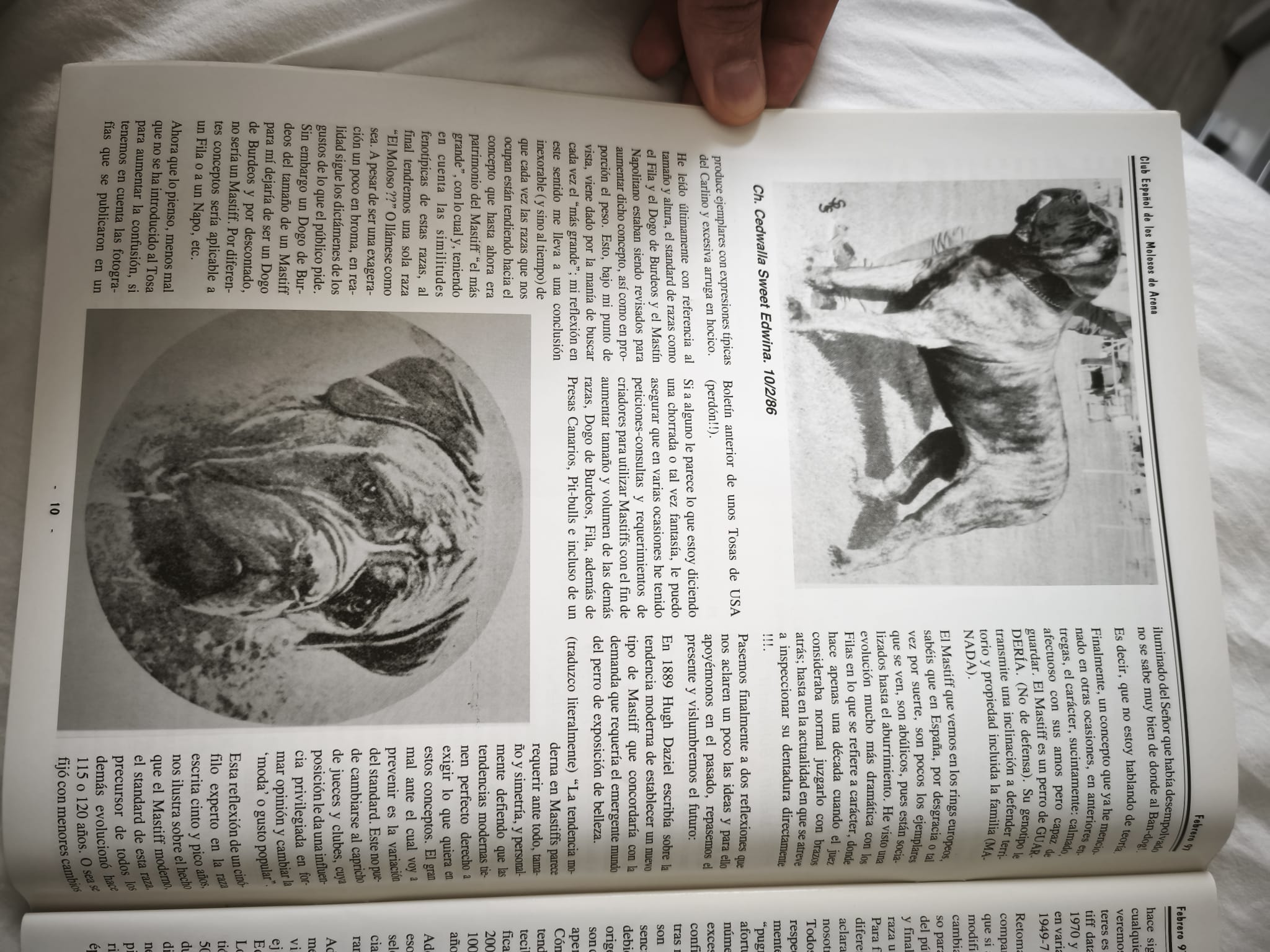
Ch. Cedwalla Sweet Edwina. 10/2/86.
Now that I think about it, it is just as well that the Tosa has not been introduced to increase the confusion, if we take into account the photographs that were published in a previous bulletin of some Tosas from the USA. Forgive me!
If anyone thinks what I am saying is nonsense or perhaps fantasy, I can assure you that on several occasions I have had requests, consultations and inquiries from breeders to use Mastiff in order to increase the size and volume of other breeds: Dogue de Bordeaux, Fila, as well as Presa Canario, Pit Bulls and even from some enlightened man of God who had dusted off, from who knows where, the Bandog.
That is to say, I am not speaking theoretically.
Finally, a concept that I have already mentioned on other occasions, in previous installments: temperament, succinctly, calm, affectionate with its owners but capable of GUARDING. The Mastiff is a guard dog, not a defense dog. Its genotype transmits an inclination to defend territory and property, including the family, the PACK.
The Mastiff we know in European rings — you know that in Spain, unfortunately or perhaps fortunately, there are few specimens to be seen — is apathetic, because it has been socialized to the point of boredom. I have seen a much more dramatic evolution with Filas as regards temperament, where barely a decade ago the judge considered it normal to judge it with his arm behind his back; while today he dares to inspect its teeth directly.
Let us finally move on to two reflections that may clarify our ideas a little and, for this, let us rely on the past, review the present and glimpse the future:
In 1889, Hugh Dalziel wrote about the modern tendency to establish a new type of Mastiff that would agree with the demand required by the emerging world of the beauty show dog.
I translate literally:
“The modern tendency in Mastiffs seems to require above all size and symmetry, and I personally maintain that modern tendencies have every right to demand whatever they want in these concepts. The great evil against which I am going to warn is the variation of the standard. It cannot be changed at the whim of judges and clubs, whose position gives them a privileged influence in forming opinion and changing ‘fashion’ or popular taste.”
This reflection by a cynologist expert in the breed, written more than a hundred years ago, illustrates the fact that the modern Mastiff, the standard of this breed, precursor of all the others, evolved 115 or 120 years ago. In other words, it was established, with minor changes, more than a century ago. If we compare it with any of the other Molosser breeds, we will see that the advantage in the fixation of traits is tremendous. The Bullmastiff standard dates from 1924, the Dogue de Bordeaux from 1970, and they are still pending evaluation in several breeds, such as the Neapolitan Mastiff 1949-71; the Fila 1984.
Returning to Dalziel’s reflection and sharing his conclusion, we summarize: yes to the evolution of breeds, without modifying the spirit of the standard or changing the type, and no to capricious change to satisfy marketing and public demand, with the danger of confusing ourselves and finally not knowing whether we are facing one breed or another.
To conclude, a point that I have touched upon on different occasions and that should be clarified in words so as not to deceive ourselves.
All of us who write about our respective breeds tirelessly invoke the millenary antiquity of this or that “pugnaces”, with more or less fortunate use of Latin terms that on many occasions are not used with excessive accuracy. In fact, we cannot scientifically confirm that they are our breeds. I would dare to say that they are NOT our breeds, for a very simple reason: the detailed definition of breeds, duly contrasted with studbooks, pedigrees, etc., are concepts from only a few years ago. How can we pretend, however appealing it may be, to justify dogs from 200 years ago, let alone 1000, 1500 or 2000 years ago?
Moreover, in all those years, the possible selection that was made, or might have been made, would have been purely functional.
Furthermore, only 200 years ago, a journey, for example, from Edinburgh to London would have been a matter of seven days. Five hundred years ago, that journey would have lasted 14 days. The difficulty of maintaining a minimum of type, phenotype, would have been tremendous. What could we say about Roman times?
Another common fallacy used is that of engravings from past times. How can anyone claim that the engravings of Goya’s bullfighting scenes belong to and serve as justification for the affiliation of traits at the same time in breeds such as the Neapolitan Mastiff and the Dogue de Bordeaux? Either they are or they are not the same breed and, in any case, why would these breeds have been used in bullfighting events when in our country there existed the Spanish presa dog?
I could continue giving examples to the point of boredom, but I do not think it necessary.
The only conclusion that can be reached is that our breeds are of very recent creation, perhaps with a faint tint of antiquity with certain groups of related dogs no further back than 200 years. The rest is fantasy. From the present, let us take care of what has been handed down to us and preserve, without losing the identity of each one of them, the characteristics that are the heritage of the others... even if they are cousins.
Ch. Forefoot Prince Igor of Brewardine. 1977.
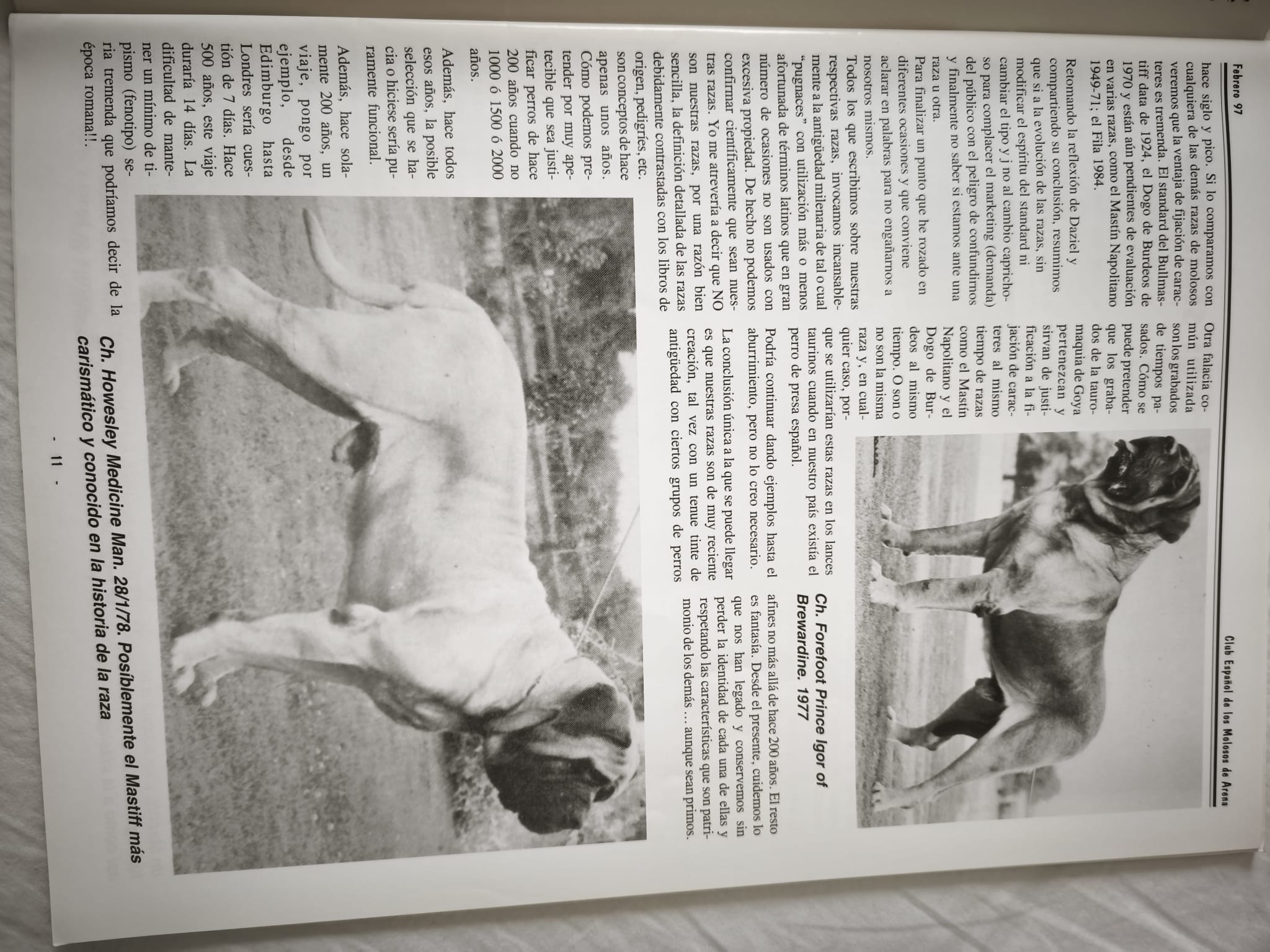
Ch. Howesley Medicine Man. 28/1/78. Possibly the most charismatic and well-known Mastiff in the history of the breed.
Frequently asked questions
What are the main differences between a Mastiff and a Bullmastiff?
The main differences lie in size, trunk length (Mastiff is rectangular, Bullmastiff is more square), and the muzzle-skull relationship. Historically, differentiation was also functional.
How does the Fila Brasileiro differ from a Mastiff?
The Fila Brasileiro differs significantly in head shape, particularly the ear set and fall, eye shape, and the presence of a moderately pronounced stop and frontal wrinkle in the Mastiff, which are less pronounced or different in the Fila.
What distinguishes a Neapolitan Mastiff from a Mastiff?
Key distinctions include the abundant wrinkle of the Neapolitan, which is atypical in the Mastiff, and the eye configuration. The Mastiff requires clean eyes with no visible conjunctiva, unlike its Italian cousin.
What is the author's concern about modern breed trends?
The author is concerned about the indiscriminate use of crosses, the exaggerated search for size, and the tendency to justify modern breeds with imprecise historical references, potentially leading to a loss of breed identity.
What is the ideal temperament for a Mastiff?
The Mastiff is described as calm and affectionate with owners, but capable of guarding. It is a guard dog, not a defense dog, with an inclination to defend territory and property.
Related articles
Colors in the Molosos de Arena, September 1994
Author: Gilbert de Mulder Published in: “Club Español de los Molosos de Arena” Date: September 1994 English translation: artificial intelligence The article introduces a series dedicated to the genetics of coat color in the breeds grouped as Molosos de Arena. Gilbert de Mulder explains the basic functioning of genes and alleles related to coat color, focusing especially on the “S” locus and its influence on the appearance of white markings. The text analyzes specific cases in the Mastiff, Bullmastiff, Neapolitan Mastiff, Dogue de Bordeaux and Fila Brasileiro, defending the importance of studying pedigrees and breeding lines in order to avoid undesirable genetic combinations.
Colors in the Fila Brasileiro, July 1993
Published in: “Club Español de los Molosos de Arena” Date: July 1993 English translation: artificial intelligence The article addresses the controversy surrounding accepted colors in the Fila Brasileiro and defends the CAFIB position regarding the rejection of black as a correct color in the breed. Mar Olivas Tur argues that other colors and combinations, such as white, brindle, sand and cinza champagne, are part of the history and authenticity of the Fila. The text insists that the quality of a specimen should not be judged exclusively by the color of its coat, but by its correctness, typicity and racial value.
The ideal age to breed the male and female Fila Brasileiro, April 1994
Author: Paulo Santos Cruz The article analyzes the reasons why CAFIB established restrictive rules regarding the minimum breeding age and the rest periods between litters in the Fila Brasileiro. Paulo Santos Cruz argues that sexual maturity is not the same as full physical maturity, especially in large and molossoid breeds. The author explains that breeding males and females too early can harm the health of the dogs, weaken selection, and compromise the quality of the breed. The article was published by Paulo Santos Cruz in the magazine “CLUB ESPAÑOL DE LOS MOLOSOS DE ARENA” in April 1994 and translated by artificial intelligence.
Dysplasia in the Dogue de Bordeaux, September 1994
Author: Dr. Fontaine Published in: “Club Español de los Molosos de Arena” Date: September 1994 Lecture: Saturday, 6/11/93 Spanish translation: P. Llorca English translation: artificial intelligence The article records a lecture by Dr. Fontaine on dysplasia in the Dogue de Bordeaux. The text addresses hereditary, environmental, nutritional and exercise-related factors that may influence the appearance or worsening of dysplasia. It also explains the importance of radiography, correct positioning of the dog, the first hip-reading statistics in the breed and the need to carry out controls before using dogs for breeding.
Round table around judge Bill Warren
Author: Begoña Pascua Interviewee: Bill Warren Published in: 2000 English translation: artificial intelligence The article records a round table with judge Bill Warren about the Bullmastiff. Through questions and answers, it discusses key aspects of the breed such as bite, prognathism, mask, ears, bone, movement, dysplasia, temperament, family breeding versus large-kennel breeding, and the difference between English and American lines. The text stresses the importance of always judging the dog as a whole, preserving breed type and breeding with common sense.
Versatility in the Fila Brasileiro, July 1993
Author: Clelia Kruel Drawing: Camburi do Embrema Published in: “Club Español de los Molosos de Arena” Date: July 1993 English translation: artificial intelligence The article presents the Fila Brasileiro as a breed deeply linked to Brazil’s rural history and highlights its versatility as a guard dog, hunting dog, companion and working dog. Clelia Kruel reviews its evolution from the Brazilian countryside to the cities, its international recognition and its role as a utility dog under extreme conditions, especially in tests carried out in the Amazon jungle. The text emphasizes its rusticity, endurance, sense of smell, strength, temperament and silent guarding ability.