
Dysplasia in the Dogue de Bordeaux, September 1994
Author: Dr. Fontaine Published in: “Club Español de los Molosos de Arena” Date: September 1994 Lecture: Saturday, 6/11/93 Spanish translation: P. Llorca English translation: artificial intelligence The article records a lecture by Dr. Fontaine on dysplasia in the Dogue de Bordeaux. The text addresses hereditary, environmental, nutritional and exercise-related factors that may influence the appearance or worsening of dysplasia. It also explains the importance of radiography, correct positioning of the dog, the first hip-reading statistics in the breed and the need to carry out controls before using dogs for breeding.
By @a.myanimal
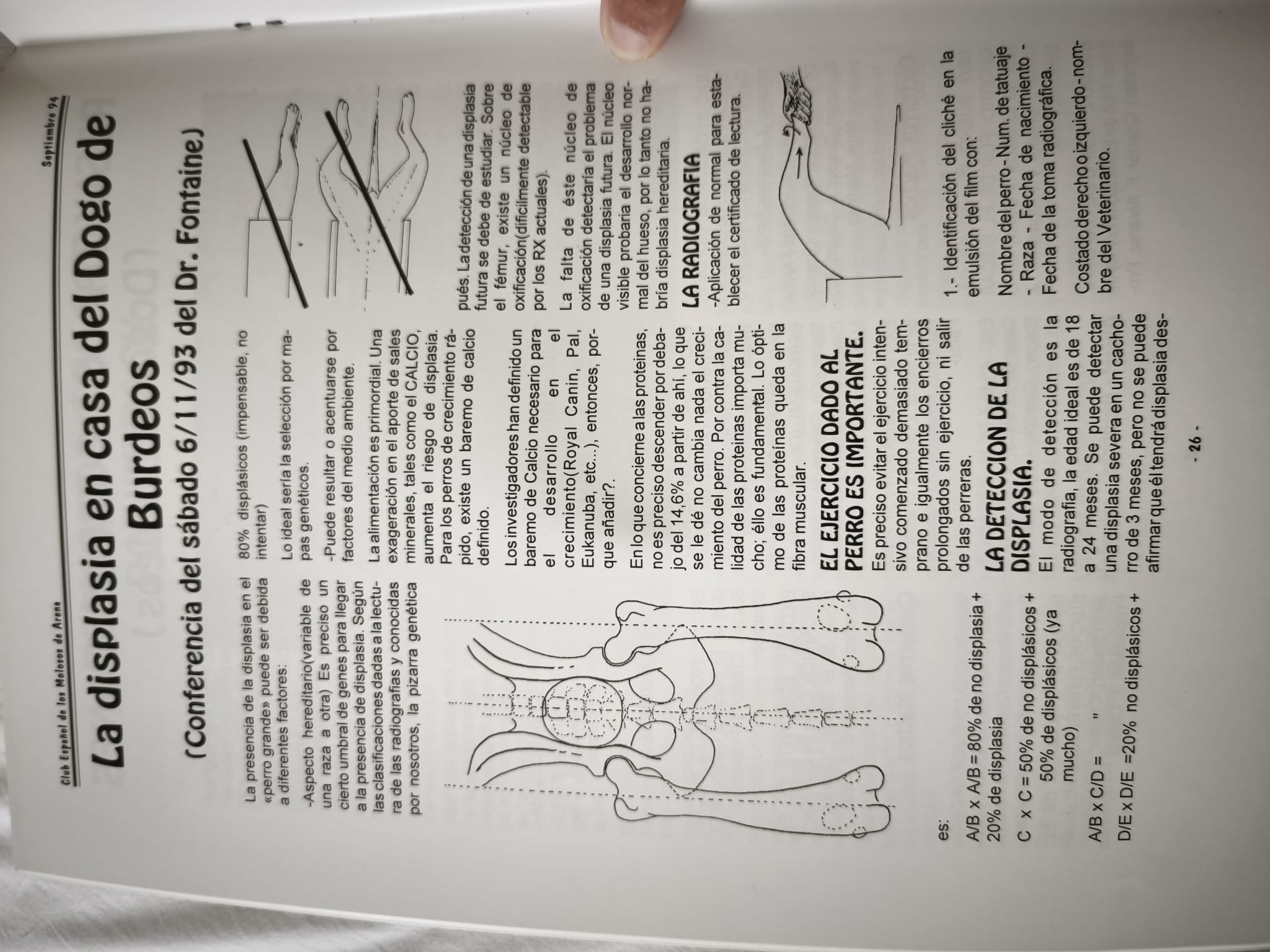
Lecture of Saturday 6/11/93 by Dr. Fontaine
The presence of dysplasia in the “large dog” may be due to different factors:
-Hereditary aspect, variable from one breed to another. A certain threshold of genes is necessary for dysplasia to appear. According to the classifications given in the reading of radiographs and known to us, the genetic board is:
A/B x A/B = 80% non-dysplastic + 20% dysplastic
C x C = 50% non-dysplastic + 50% dysplastic, already a lot
A/B x C/D = "
D/E x D/E = 20% non-dysplastic + 80% dysplastic, unthinkable, do not attempt
The ideal would be selection through genetic maps.
-It may result from or be accentuated by environmental factors.
Nutrition is essential. An exaggerated intake of mineral salts, such as CALCIUM, increases the risk of dysplasia. For fast-growing dogs, there is a defined calcium scale.
Researchers have defined a calcium scale necessary for development during growth, Royal Canin, Pal, Eukanuba, etc.; therefore, why add more?
As regards proteins, it is not necessary to go below 14.6%; beyond that, what is given does not change the growth of the dog. On the other hand, the quality of proteins matters greatly; it is fundamental. The optimum protein remains in muscle fiber.
The exercise given to the dog is important
It is necessary to avoid intensive exercise started too early, and also prolonged confinement without exercise or without leaving the kennels.
Detection of dysplasia
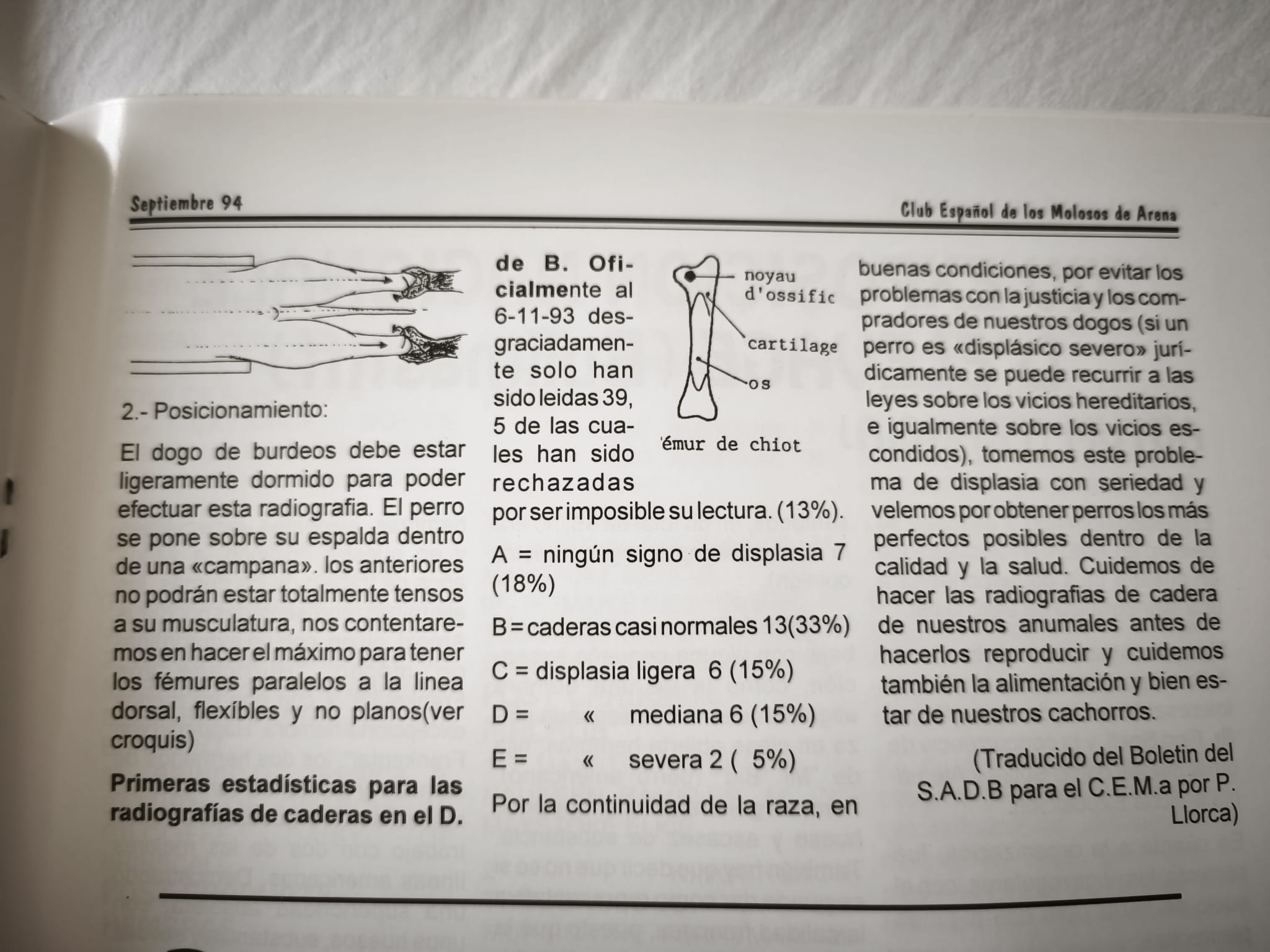
The method of detection is radiography; the ideal age is 18 to 24 months. Severe dysplasia can be detected in a 3-month-old puppy, but it cannot be stated that it will have dysplasia later. The detection of future dysplasia must be studied. On the femur, there is an ossification nucleus, difficult to detect with current X-rays.
The absence of this ossification nucleus would detect the problem of future dysplasia. A visible nucleus would prove normal bone development; therefore, there would be no hereditary dysplasia.
Radiography
-Application of the standard to establish the reading certificate.
1.- Identification of the cliché on the film emulsion with:
Name of the dog - Tattoo number - Breed - Date of birth - Date of radiographic taking.
Right or left side - name of the veterinarian.
2.- Positioning:
The Dogue de Bordeaux must be lightly sedated in order to carry out this radiograph. The dog is placed on its back inside a “bell”. The forequarters cannot be completely tense in their musculature; we will be content to do our best to have the femurs parallel to the dorsal line, flexible and not flat, see diagram.
First statistics for hip radiographs in the D. de B. Officially, on 6-11-93, unfortunately only 39 had been read, 5 of which had been rejected because reading was impossible, 13%.
A = no sign of dysplasia 7, 18%
B = almost normal hips 13, 33%
C = mild dysplasia 6, 15%
D = moderate dysplasia 6, 15%
E = severe dysplasia 2, 5%
For the continuity of the breed, in good conditions, and to avoid problems with the law and with the buyers of our dogues, if a dog is “severely dysplastic” one can legally resort to the laws on hereditary defects, and likewise on hidden defects, let us take this problem of dysplasia seriously and strive to obtain dogs as perfect as possible in quality and health. Let us take care to have hip radiographs made of our animals before breeding them, and let us also take care of the nutrition and well-being of our puppies.
Translated from the S.A.D.B. Bulletin for the C.E.M.a by P. Llorca.
Frequently asked questions
What factors contribute to dysplasia in large dog breeds?
Factors include hereditary aspects, environmental influences, nutrition (especially excessive calcium intake), and exercise levels. An exaggerated intake of mineral salts like CALCIUM increases the risk.
What is the ideal age for detecting hip dysplasia through radiography?
The ideal age for radiography to detect hip dysplasia is between 18 to 24 months. While severe dysplasia can sometimes be seen in 3-month-old puppies, future development cannot be definitively predicted at that age.
How is radiography performed for dysplasia detection in Dogue de Bordeaux?
The Dogue de Bordeaux is lightly sedated and placed on its back. The goal is to position the femurs parallel to the dorsal line, ensuring they are flexible and not flat, for accurate imaging.
What were the initial hip radiography statistics for the Dogue de Bordeaux breed in 1993?
As of November 6, 1993, out of 39 hip radiographs read, 5 were rejected. The statistics showed: A (no sign) 7.18%, B (almost normal) 13.33%, C (mild) 6.15%, D (moderate) 6.15%, and E (severe) 2.5%.
Why is it important to control for dysplasia before breeding?
Controlling for dysplasia before breeding is crucial for the continuity and health of the breed. It helps avoid legal issues related to hereditary or hidden defects and ensures healthier puppies for buyers.
Related articles
Colors in the Molosos de Arena, September 1994
Author: Gilbert de Mulder Published in: “Club Español de los Molosos de Arena” Date: September 1994 English translation: artificial intelligence The article introduces a series dedicated to the genetics of coat color in the breeds grouped as Molosos de Arena. Gilbert de Mulder explains the basic functioning of genes and alleles related to coat color, focusing especially on the “S” locus and its influence on the appearance of white markings. The text analyzes specific cases in the Mastiff, Bullmastiff, Neapolitan Mastiff, Dogue de Bordeaux and Fila Brasileiro, defending the importance of studying pedigrees and breeding lines in order to avoid undesirable genetic combinations.
Goal and responsibility of the individual breeder in the breeding of the Dogue de Bordeaux, April 1994
Author: F. Schulthoff, Head of Litter Inspection of the Deutscher Bordeaux-Doggen Klub Translator cited in the article: Ines Van Damme English translation: artificial intelligence Date of the lecture: August 29, 1993, München-Gladbach, Germany Published in: “Club Español de los Molosos de Arena”, April 1994 Source cited in the article: Bulletin of the Dutch Molosser Club The article addresses the individual responsibility of the breeder in the preservation and improvement of the Dogue de Bordeaux. F. Schulthoff argues that the goal should not be to multiply dogs, but to breed healthy, typical and correctly selected specimens. The author warns about the risks of breeding without clear criteria, subjective interpretation of the standard, insufficient pedigree study and the need to work with a long-term vision in order to avoid the loss of health, type and genetic stability in the breed.
Mastiff, Bullmastiff, Fila Brasileiro, Dogue de Bordeaux and Neapolitan Mastiff: together, but not mixed, February 1997
Author: J. M. Castillo Published in: “Club Español de los Molosos de Arena” Date: February 1997 Original translation: not indicated in the article English translation: artificial intelligence The article analyzes the morphological, historical and functional differences between several molossoid breeds included within the group known as “Molosos de Arena”. J. M. Castillo focuses especially on the Mastiff and compares it with the Bullmastiff, the Fila Brasileiro, the Neapolitan Mastiff and the Dogue de Bordeaux. The author warns against confusion between breeds, the indiscriminate use of crosses, the exaggerated search for size and the tendency to justify modern breeds through imprecise historical references. His main thesis is that these breeds may be related, but they must preserve their identity, type and specific characteristics.
Colors in the Fila Brasileiro, July 1993
Published in: “Club Español de los Molosos de Arena” Date: July 1993 English translation: artificial intelligence The article addresses the controversy surrounding accepted colors in the Fila Brasileiro and defends the CAFIB position regarding the rejection of black as a correct color in the breed. Mar Olivas Tur argues that other colors and combinations, such as white, brindle, sand and cinza champagne, are part of the history and authenticity of the Fila. The text insists that the quality of a specimen should not be judged exclusively by the color of its coat, but by its correctness, typicity and racial value.
Tosa-Inu: the noble samurai
Author/commentary: D. Javier Sánchez Fernández, international judge Published in: “CLUB ESPAÑOL DE LOS MOLOSOS DE ARENA” magazine Date: 2000 English translation: artificial intelligence D. Javier Sánchez Fernández analyzes the Tosa-Inu from his experience as an international judge and expert on Japanese breeds. The article addresses the cultural value of the Tosa in Japan, its relationship with samurai tradition, its character as a ceremonial fighting dog, the difficulty of accessing authentic specimens outside Japan, and the risks of losing typicity when the breed is interpreted through Western show criteria. The importance of head, expression, mobility, temperament and preservation of racial identity is also emphasized.
The ideal age to breed the male and female Fila Brasileiro, April 1994
Author: Paulo Santos Cruz The article analyzes the reasons why CAFIB established restrictive rules regarding the minimum breeding age and the rest periods between litters in the Fila Brasileiro. Paulo Santos Cruz argues that sexual maturity is not the same as full physical maturity, especially in large and molossoid breeds. The author explains that breeding males and females too early can harm the health of the dogs, weaken selection, and compromise the quality of the breed. The article was published by Paulo Santos Cruz in the magazine “CLUB ESPAÑOL DE LOS MOLOSOS DE ARENA” in April 1994 and translated by artificial intelligence.