
Goal and responsibility of the individual breeder in the breeding of the Dogue de Bordeaux, April 1994
Author: F. Schulthoff, Head of Litter Inspection of the Deutscher Bordeaux-Doggen Klub Translator cited in the article: Ines Van Damme English translation: artificial intelligence Date of the lecture: August 29, 1993, München-Gladbach, Germany Published in: “Club Español de los Molosos de Arena”, April 1994 Source cited in the article: Bulletin of the Dutch Molosser Club The article addresses the individual responsibility of the breeder in the preservation and improvement of the Dogue de Bordeaux. F. Schulthoff argues that the goal should not be to multiply dogs, but to breed healthy, typical and correctly selected specimens. The author warns about the risks of breeding without clear criteria, subjective interpretation of the standard, insufficient pedigree study and the need to work with a long-term vision in order to avoid the loss of health, type and genetic stability in the breed.
By @a.myanimal
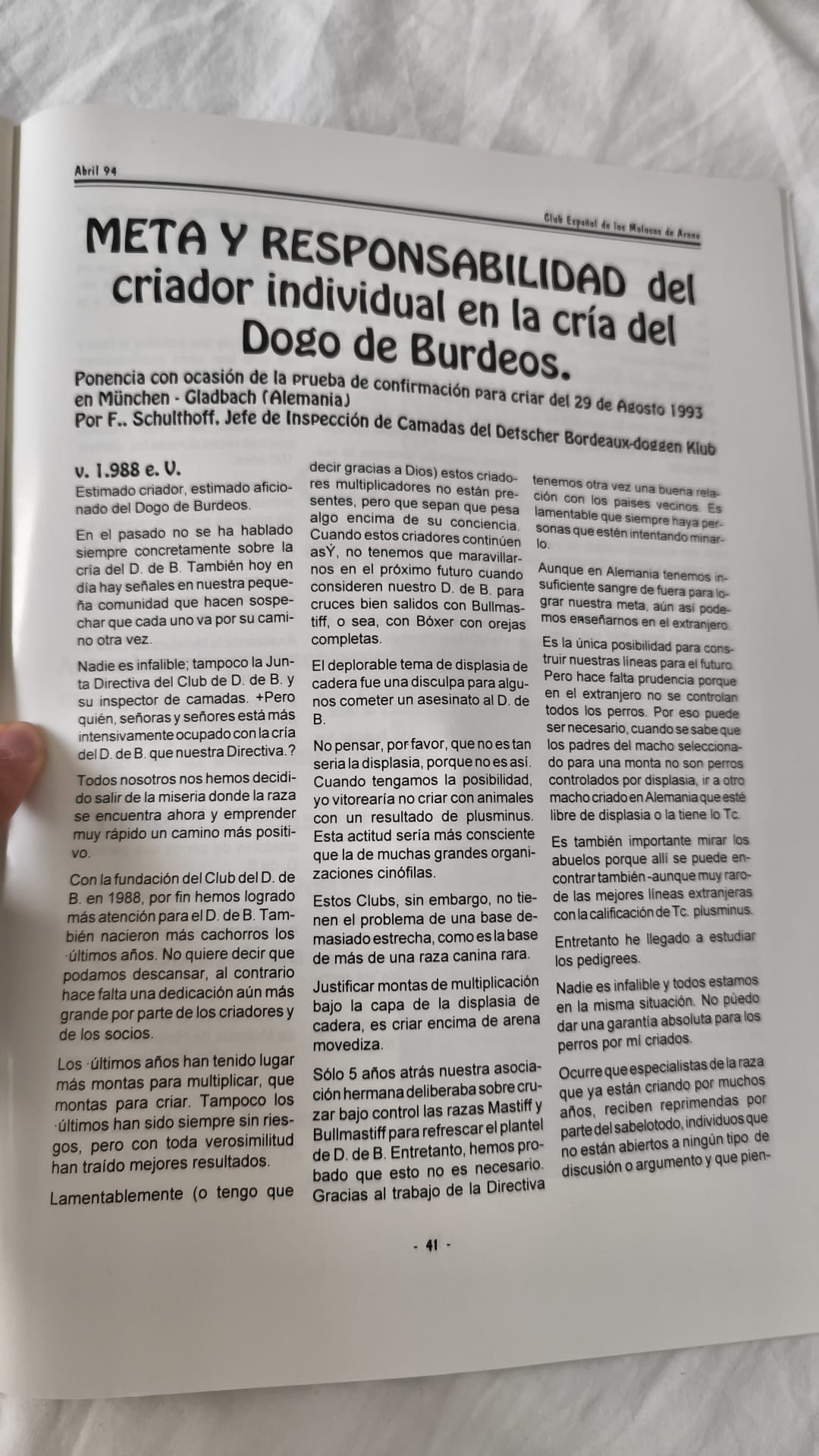
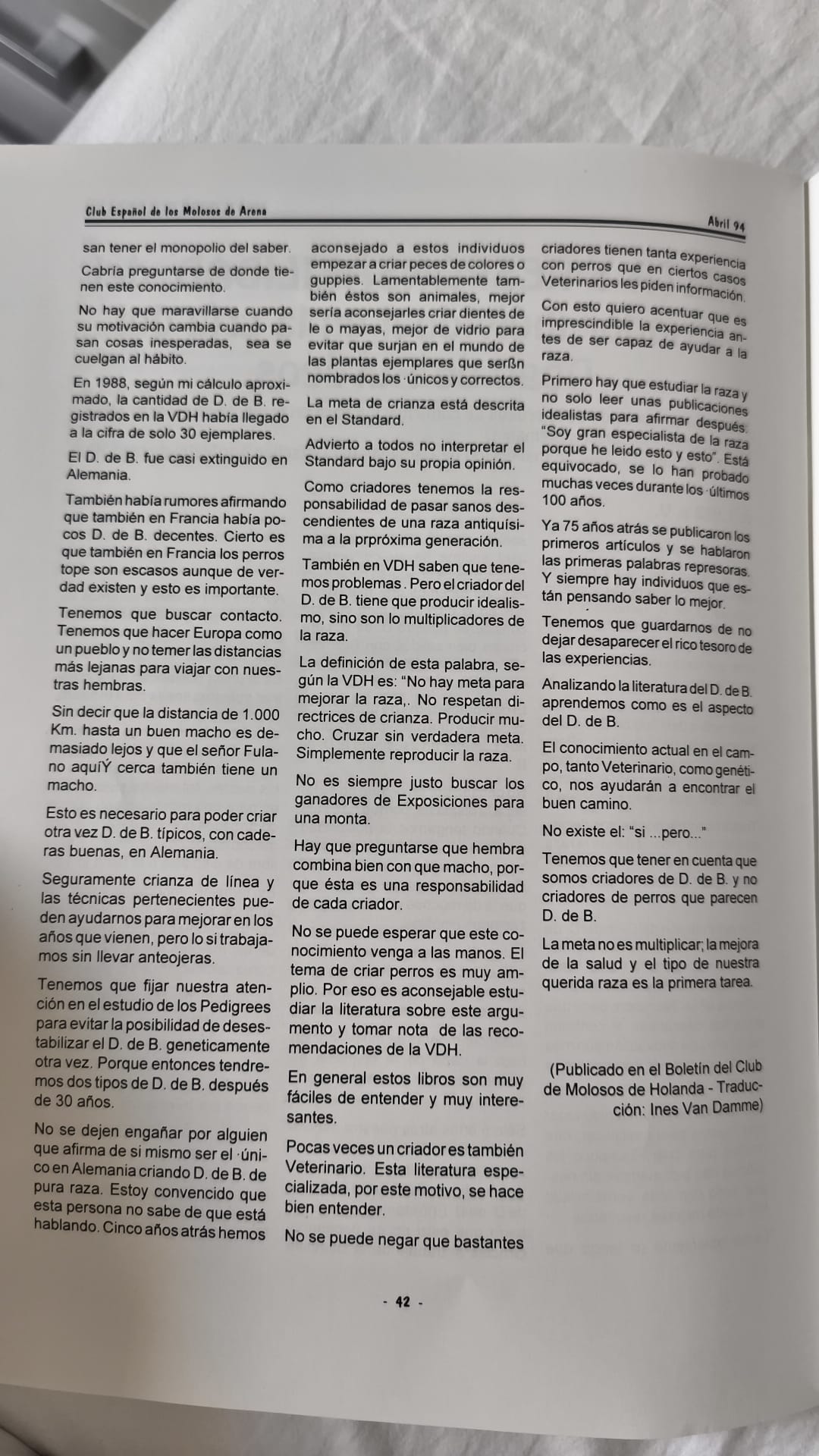
Author: F. Schulthoff Translator cited in the article: Ines Van Damme English translation: artificial intelligence
GOAL AND RESPONSIBILITY of the individual breeder in the breeding of the Dogue de Bordeaux.
Lecture on the occasion of the confirmation test for breeding, August 29, 1993, in München-Gladbach, Germany. By F. Schulthoff, Head of Litter Inspection of the Deutscher Bordeaux-Doggen Klub v. 1988 e.V.
Dear breeder, dear Dogue de Bordeaux enthusiast,
In the past, people have not always spoken specifically about the breeding of the D. de B. Even today, there are signs in our small community that make one suspect that everyone is once again going their own way.
No one is infallible; neither the Board of Directors of the D. de B. Club nor its litter inspector. But who, ladies and gentlemen, is more intensively involved with the breeding of the D. de B. than our Board?
All of us have decided to leave behind the misery in which the breed now finds itself and to take, very quickly, a more positive path.
With the founding of the D. de B. Club in 1988, we finally achieved greater attention for the D. de B. More puppies have also been born in recent years. This does not mean that we can rest; on the contrary, even greater dedication is needed from breeders and members.
In recent years there have been more matings for multiplication than matings for breeding. The latter have not always been without risk either, but in all likelihood they have brought better results.
Unfortunately — or should I say, thank God — these multiplier breeders are not present, but let them know that something weighs on their conscience. If these breeders continue in this way, we should not be surprised in the near future when they consider our D. de B. to be the result of successful crosses with Bullmastiff, that is, with Boxer with complete ears.
The deplorable issue of hip dysplasia was an excuse for some to commit an assassination of the D. de B.
Please do not think that dysplasia is not serious, because it is. If we had the possibility, I would applaud not breeding with animals that have a plus-minus result. This attitude would be more responsible than that of many large cynological organizations.
These clubs, however, do not have the problem of an excessively narrow base, as is the case with more than one rare canine breed.
To justify multiplication matings under the cloak of hip dysplasia is to breed on shifting sand.
Only five years ago, our sister association was deliberating about controlled crosses between the Mastiff and Bullmastiff breeds in order to refresh the D. de B. stock. Meanwhile, we have proven that this is not necessary. Thanks to the work of the Board, we once again have a good relationship with neighboring countries. It is regrettable that there are always people trying to undermine it.
Although in Germany we have insufficient outside blood to achieve our goal, we can still learn from abroad.
It is the only possibility for building our lines for the future. But prudence is needed, because abroad not all dogs are controlled. For that reason, it may be necessary, when it is known that the parents of the male selected for a mating are not dogs checked for dysplasia, to go to another male bred in Germany that is free from dysplasia or has the Tc classification.
It is also important to look at the grandparents, because there one may also find — although very rarely — some of the best foreign lines with the Tc plus-minus qualification.
In the meantime, I have come to study pedigrees.
No one is infallible, and we are all in the same situation. I cannot give an absolute guarantee for the dogs bred by me.
It happens that breed specialists who have been breeding for many years receive reprimands from know-it-alls, individuals who are not open to any kind of discussion or argument and who think they have a monopoly on knowledge.
One might ask where they get this knowledge from.
There is no need to be surprised when their motivation changes when unexpected things happen, or when they cling to habit.
In 1988, according to my approximate calculation, the number of D. de B. registered with the VDH had reached only 30 specimens.
The D. de B. was almost extinct in Germany.
There were also rumors claiming that in France there were few decent D. de B. specimens as well. It is true that top dogs are also scarce in France, although they really do exist, and this is important.
We must seek contact. We must make Europe like one people and not fear the longer distances in order to travel with our females.
Without saying that a distance of 1,000 km to a good male is too far and that Mr. So-and-so nearby also has a male.
This is necessary in order to once again breed typical D. de B. dogs with good hips in Germany.
Surely line breeding and the related techniques can help us improve in the coming years, but only if we work without wearing blinkers.
We must focus our attention on the study of pedigrees in order to avoid the possibility of genetically destabilizing the D. de B. once again. Otherwise, after 30 years, we will have two types of D. de B.
Do not let yourselves be deceived by someone who claims to be the only person in Germany breeding purebred D. de B. I am convinced that this person does not know what he is talking about. Five years ago, we advised these individuals to start breeding goldfish or guppies. Unfortunately, these are also animals; it would be better to advise them to grow dandelions or daisies, preferably made of glass, to avoid specimens appearing in the plant world that will be declared the only and correct ones.
The breeding goal is described in the Standard.
I warn everyone not to interpret the Standard according to their own opinion.
As breeders, we have the responsibility to pass on healthy descendants of an ancient breed to the next generation.
They also know at the VDH that we have problems. But the D. de B. breeder must produce idealism; otherwise, they are simply multipliers of the breed.
The definition of this word, according to the VDH, is: “There is no goal to improve the breed. They do not respect breeding guidelines. Producing a lot. Crossing without a true goal. Simply reproducing the breed.”
It is not always right to look for show winners for a mating.
One must ask which female combines well with which male, because this is the responsibility of each breeder.
One cannot expect this knowledge to simply fall into one’s hands. The subject of breeding dogs is very broad. For that reason, it is advisable to study the literature on this matter and take note of the recommendations of the VDH.
In general, these books are very easy to understand and very interesting.
Rarely is a breeder also a veterinarian. This specialized literature, for that reason, is made easy to understand.
It cannot be denied that quite a few breeders have so much experience with dogs that, in certain cases, veterinarians ask them for information.
With this I want to emphasize that experience is essential before being capable of helping the breed.
First, one must study the breed and not merely read a few idealistic publications in order to later claim: “I am a great specialist of the breed because I have read this and that.” This is wrong; it has been proven many times over the last 100 years.
Already 75 years ago the first articles were published and the first warning words were spoken. And there are always individuals who think they know best.
We must be careful not to let the rich treasure of experience disappear.
By analyzing the literature on the D. de B., we learn what the appearance of the D. de B. is.
Current knowledge in the field, both veterinary and genetic, will help us find the right path.
There is no “yes, but...”
We must bear in mind that we are breeders of D. de B., and not breeders of dogs that merely look like D. de B.
The goal is not multiplication; the improvement of the health and type of our beloved breed is the first task.
Published in the Bulletin of the Dutch Molosser Club. Translation: Ines Van Damme.
Frequently asked questions
What is the primary goal of a Dogue de Bordeaux breeder?
The primary goal is not to multiply dogs, but to breed healthy, typical, and correctly selected specimens that preserve the breed's health, type, and genetic stability.
What are the risks of breeding without clear criteria?
Breeding without clear criteria, subjective interpretation of the standard, insufficient pedigree study, and a lack of long-term vision can lead to the loss of health, type, and genetic stability in the breed.
How important is pedigree study in Dogue de Bordeaux breeding?
Pedigree study is crucial to avoid genetically destabilizing the Dogue de Bordeaux and to ensure the breed's future. It helps in selecting appropriate pairings for health and type.
What is the definition of a 'multiplier' breeder according to the VDH?
According to the VDH, a multiplier breeder has no goal to improve the breed, does not respect breeding guidelines, produces a lot, and crosses without a true goal, simply reproducing the breed.
What is the stance on hip dysplasia in Dogue de Bordeaux breeding?
Hip dysplasia is a serious issue. Responsible breeding involves considering health results, and some advocate for not breeding with animals that have a plus-minus result for dysplasia.
Related articles
Colors in the Molosos de Arena, September 1994
Author: Gilbert de Mulder Published in: “Club Español de los Molosos de Arena” Date: September 1994 English translation: artificial intelligence The article introduces a series dedicated to the genetics of coat color in the breeds grouped as Molosos de Arena. Gilbert de Mulder explains the basic functioning of genes and alleles related to coat color, focusing especially on the “S” locus and its influence on the appearance of white markings. The text analyzes specific cases in the Mastiff, Bullmastiff, Neapolitan Mastiff, Dogue de Bordeaux and Fila Brasileiro, defending the importance of studying pedigrees and breeding lines in order to avoid undesirable genetic combinations.
Dysplasia in the Dogue de Bordeaux, September 1994
Author: Dr. Fontaine Published in: “Club Español de los Molosos de Arena” Date: September 1994 Lecture: Saturday, 6/11/93 Spanish translation: P. Llorca English translation: artificial intelligence The article records a lecture by Dr. Fontaine on dysplasia in the Dogue de Bordeaux. The text addresses hereditary, environmental, nutritional and exercise-related factors that may influence the appearance or worsening of dysplasia. It also explains the importance of radiography, correct positioning of the dog, the first hip-reading statistics in the breed and the need to carry out controls before using dogs for breeding.
Mastiff, Bullmastiff, Fila Brasileiro, Dogue de Bordeaux and Neapolitan Mastiff: together, but not mixed, February 1997
Author: J. M. Castillo Published in: “Club Español de los Molosos de Arena” Date: February 1997 Original translation: not indicated in the article English translation: artificial intelligence The article analyzes the morphological, historical and functional differences between several molossoid breeds included within the group known as “Molosos de Arena”. J. M. Castillo focuses especially on the Mastiff and compares it with the Bullmastiff, the Fila Brasileiro, the Neapolitan Mastiff and the Dogue de Bordeaux. The author warns against confusion between breeds, the indiscriminate use of crosses, the exaggerated search for size and the tendency to justify modern breeds through imprecise historical references. His main thesis is that these breeds may be related, but they must preserve their identity, type and specific characteristics.
Colors in the Fila Brasileiro, July 1993
Published in: “Club Español de los Molosos de Arena” Date: July 1993 English translation: artificial intelligence The article addresses the controversy surrounding accepted colors in the Fila Brasileiro and defends the CAFIB position regarding the rejection of black as a correct color in the breed. Mar Olivas Tur argues that other colors and combinations, such as white, brindle, sand and cinza champagne, are part of the history and authenticity of the Fila. The text insists that the quality of a specimen should not be judged exclusively by the color of its coat, but by its correctness, typicity and racial value.
Tosa-Inu: the noble samurai
Author/commentary: D. Javier Sánchez Fernández, international judge Published in: “CLUB ESPAÑOL DE LOS MOLOSOS DE ARENA” magazine Date: 2000 English translation: artificial intelligence D. Javier Sánchez Fernández analyzes the Tosa-Inu from his experience as an international judge and expert on Japanese breeds. The article addresses the cultural value of the Tosa in Japan, its relationship with samurai tradition, its character as a ceremonial fighting dog, the difficulty of accessing authentic specimens outside Japan, and the risks of losing typicity when the breed is interpreted through Western show criteria. The importance of head, expression, mobility, temperament and preservation of racial identity is also emphasized.
The ideal age to breed the male and female Fila Brasileiro, April 1994
Author: Paulo Santos Cruz The article analyzes the reasons why CAFIB established restrictive rules regarding the minimum breeding age and the rest periods between litters in the Fila Brasileiro. Paulo Santos Cruz argues that sexual maturity is not the same as full physical maturity, especially in large and molossoid breeds. The author explains that breeding males and females too early can harm the health of the dogs, weaken selection, and compromise the quality of the breed. The article was published by Paulo Santos Cruz in the magazine “CLUB ESPAÑOL DE LOS MOLOSOS DE ARENA” in April 1994 and translated by artificial intelligence.